


Key Takeaways
- The Ruger LCP has been on the market for 18 years, but it still offers reliable performance as a pocket gun.
- It is small and easy to carry, yet its size affects shooting difficulty and accuracy with typical .380 loads.
- The trigger is heavier compared to striker-fired guns, but with practice, users can manage it well.
- The LCP fits a niche as a convenient backup firearm, despite better options being available for more money.
- Overall, the LCP remains a valuable choice for those needing a lightweight pocket gun.
Estimated reading time: 6 minutes
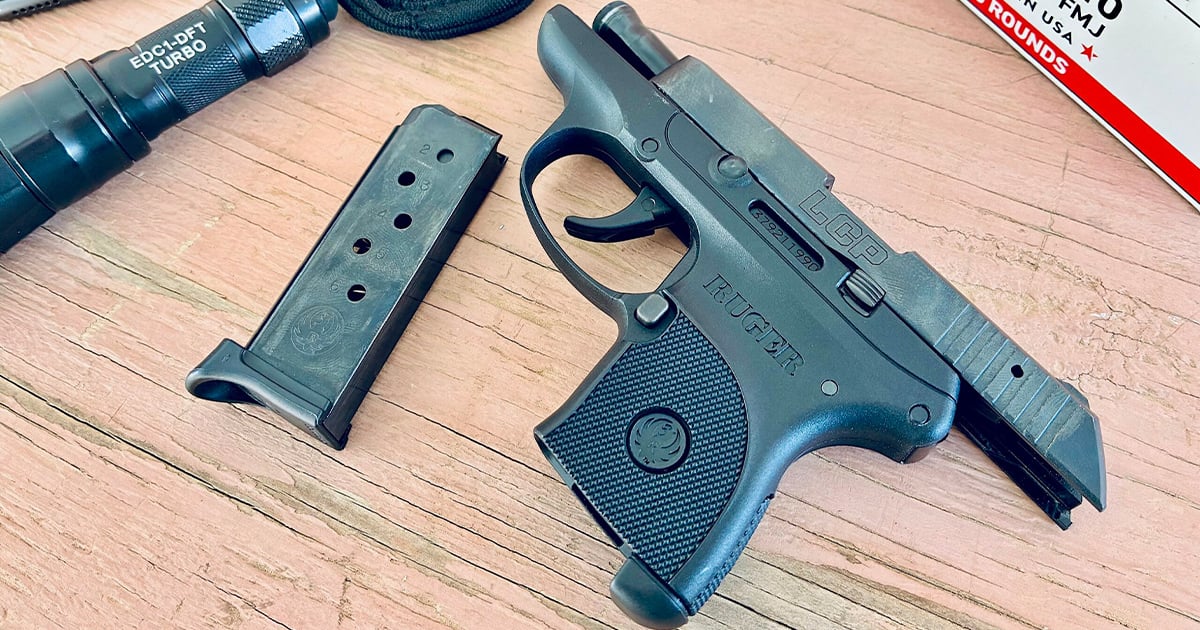
The Ruger LCP is nothing new. In its original form it has been on the market for 18 years, first released at the 2008 SHOT show. As the market has changed, the original version of the LCP has largely been overshadowed and forgotten, although I imagine there are quite a few still out there being carried in pockets. If you were to buy the elder LCP today, it would show up in a cardboard box with a single magazine, and a Ruger branded pocket holster. If you shop it around, it is not unusual to find the LCP for prices a tick (or few) under $200. Is this legacy design still worth it, or has it been surpassed by the newer and more refined versions of the LCP? I decided to have a look at what a current production LCP can do.
Pocket pistols being what pocket pistols are, most people think of them as guns for short range affairs to make the work easy. We usually don’t expect much from them. Heavy triggers with a lot of travel in a striker fired world, and minuscule fixed sights with nothing to really draw our attention to them, they maybe are a little harder to shoot than the average gun these days. That isn’t to say they are impossible though.
Size Matters – For a Pocket Gun
If you are somehow unfamiliar with the Ruger LCP’s size, it isn’t much. Next to a $20 dollar bill, a Swiss Army Knife, or a cellphone, it isn’t punching too far below its weight class. The problem of course though, that also means the amount of gun there to hang onto is on the small side of things. This makes it a little more difficult to shoot than many are willing to put up with, but not impossible.
The Unboxing
Out of the box this sample was a little clunky. Almost feeling gritty. A haphazard cleaning, a fresh coat of preferred gun oil, and a few minutes of running the slide back and forth and it seemed to improve. Seemed to. First trip to the range the gun saw about 50 rounds. Other than the slide getting a bit sluggish on one round shooting strong hand only, nothing really noteworthy. The ammunition used was Winchester’s 95gr FMJ-FP.
More from USA Carry:
400 Rounds Later
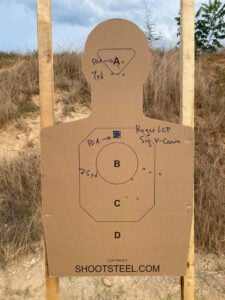
The gun does shoot a hair low with typical .380 loads. Sig V-Crown, Federal HST, Remington JHP, and WWB 95gr FMJ-FP all shoot low. Noticeable at 7 yards, but not enough to make a huge difference. Very noticeable at 25 yards, and enough to matter. Or I am too inept to use the sights that have yet to grow up into full blown adult sights. There is something about the shape of the sights that if I am not careful causes me to line them up with the front sight biased low in the rear notch. Could be a problem, but when shooting for groups, I tried my best to be careful about it and I am typically pretty good at this stuff. All groups were shot standing, unsupported (because that is how we shoot guns), and with two hands.
The trigger will probably not win over any fans. Especially for people who are used to striker fired guns. It is long-ish, and definitely heavier than what the community at large would call a good trigger. Fortunately for me, I have spent a lot of time shooting revolvers and DAO pistols, so a sort of DAO-ish trigger on the LCP isn’t proving to be much of a hurdle. One interesting thing about the LCP’s trigger is that it isn’t a true DAO system. The hammer is partially cocked, and the trigger completes cocking the hammer before releasing it forward. While I am sure this helps to make the trigger more manageable, it also means the gun does not have “double strike” capability and the slide has to cycle to shoot the gun. If the slide does not cycle, or does not completely cycle, then it is on the user to manually cycle the slide. With work, the trigger should not be an impediment to good shooting.
In Summary
So how would I describe the LCP as a total package? It is a Rule 1 gun. The first rule of any gunfight is to have a gun. This gun is easy to carry, harder to shoot, generally reliable for what it is, and the price makes it exceptionally accessible. This wouldn’t be a gun I would want to rely on in every circumstance, even though it can do a lot more than people give it credit for. Recoil as snappy (I know, we are all surprised), the sights suck, the trigger is an acquired taste, it only holds 6+1 rounds, but it fits a niche. Even though I am not generally a pocket gun kind of guy, it is incredibly convenient to have a gun that can slip into a pocket for trips to the shady parts store down the road from my house because my 45-year-old truck broke again.
Later and greater evolutions of the LCP on the market now are better, but also cost more and at some point, the dollar to performance ratio doesn’t quite work itself out. The LCP Custom was the first evolution, presumably with a more refined feel. That morphed into the LCP II, with improved features like mostly real sights, the option of a manual safety on some models (maybe not an improvement), new calibers, better ergonomics, and a slide hold open after the last round is fired like most normal modern handguns. The LCP Max came next, with a bit larger frame and capacity almost doubled, actual real sights, plus all the things that made the LCP II a better gun. It pushes the boundary of what I would personally consider a pocketable handgun, but that is just me.
TL;DR
All that being said, be careful not to sleep on Ruger’s legacy entry into the semi-auto pocket gun market place. It can still do good work, if the hands that hold it have the skill to pull it off. At the end of the day, it adequately does what we need pocket guns to do, and adequate is the name of the pocket gun game.