


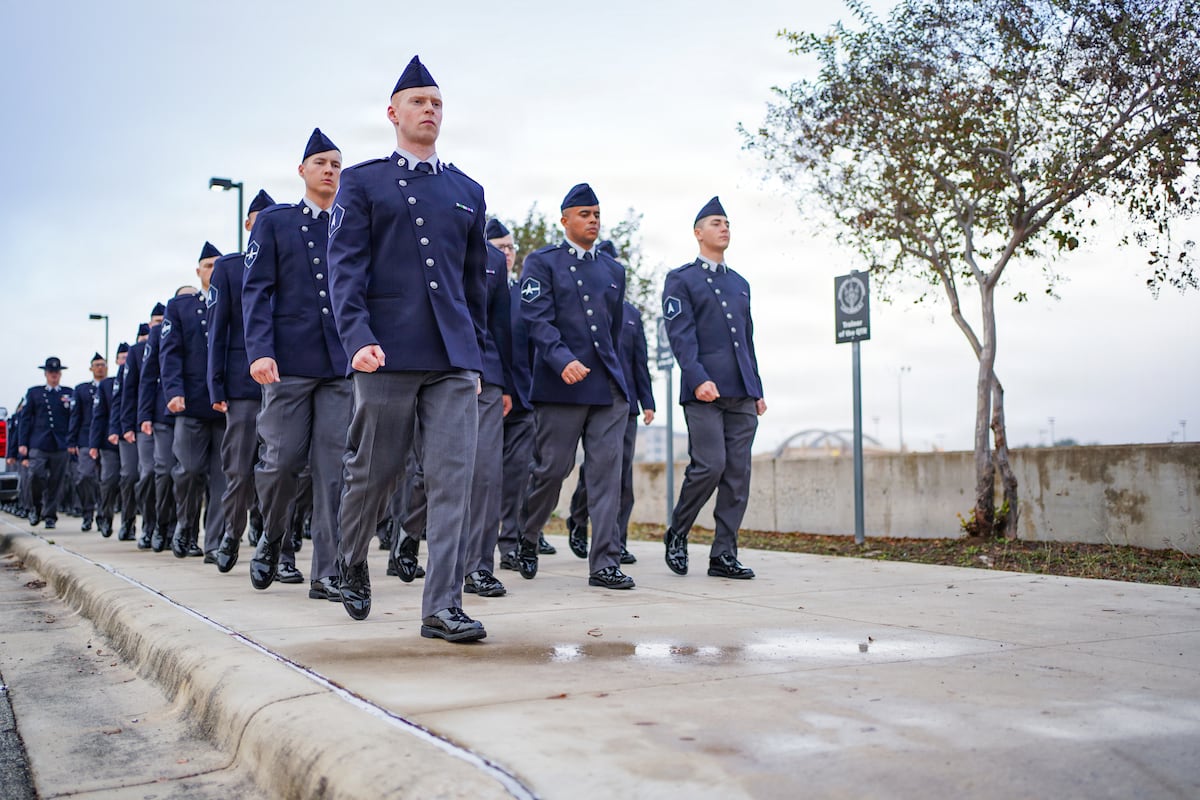
The Space Force must expand in order to accomplish its mission, says the service’s new Objective Force plan, a 100-page document outlining a vision for its structure and doctrine through 2040.
“The Space Force will require significant additional manpower and specialized expertise to generate Space Control forces able to conduct sustained operations at a global scale,” the plan says.
For example, the Space Domain Awareness mission “will demand additional analysts, operators, and engineering support with a projected growth of approximately 30% in personnel.”
The Space Force currently has around 15,000 military and civilian personnel.
The Space Force also anticipates operating — and tracking — many more satellites. The Future Operating Environment report released alongside the Objective Force plan predicts the number of satellites in orbit will more than quintuple from around 12,000 today to 60,000 in 2040.
The U.S. satellite fleet will grow from about 7,000 to 30,000, while China’s satellites will soar from 1,900 to 21,000. To keep up, the Space Force must rely on commercial space companies, the report says.
The “Spacelift and Launch Range Control Objective Force will implement the ‘Spaceport of the Future’ concept for distributed, resilient, and hybrid architecture that is commercially integrated by design,” the plan said. “Supplementing the federal spaceports, the Space Force will build a competitive marketplace in which every launch site and provider becomes a networked node in a robust, adaptive national space access enterprise.”
The Objective Force plan also suggests the Space Force develop a more sophisticated approach to offensive and defensive space warfare than merely weakening — and being weakened by — the enemy.
“By 2040, the Space Force will move beyond near-term attrition-based methods to a mature warfighting approach centered on campaigning, maneuver, and reconstitution that preserves strategic advantage without driving unnecessary escalation,” the plan states.
In turn, this will require integrated formations that combine orbital warfare, electromagnetic warfare and cyberspace warfare with the “intelligence, command and control, and battle management capacity required to fight in contested conditions.”
The Space Force will also to tackle new missions, especially assisting the kill chain with space-based sensing and targeting, as well as moving target indication to track air, ground and sea objects in real time.
“Historically, the Space Force’s Joint contribution for sensing was predominantly environmental monitoring” and providing weather data, the Objective Force plan noted.
“The SB-MTI mission will “require establishing a new Delta [mission set] along with dedicated Squadrons for the Air and Ground/Maritime capabilities. SB-MTI Guardians will need training in DAF [Air Force] and Joint fires operations, and Service Components will need to expand to support Combatant Command tasking and integration into battle management and intelligence.”
By 2035, the Space Force will be operating second- and third-generation SB-MTI systems. “Until then, the Space Force must prioritize adaptability and force presentation,” the Objective Force plan said. “For the first time, Guardians will operate MTI systems that directly enable lethal fires in all domains, and the Space Force must accomplish sufficient work to ensure their readiness and integration into the Joint Force.”
The Space Force also wants enhanced capabilities in other missions, including cyberwarfare, satellite communications, command and control, and position, navigation and timing. It foresees a future of kinetic and non-kinetic warfare where nations “convert dual-use platforms into weapons of opportunistic denial.”
Combatants will use methods such as “dense, self-healing webs of satellites, drifting high-altitude stratospheric relays, drones, and cyber agents that operate through, re-route, and overwhelm single points of failure.”
The Objective Force plan also grapples with one of the Space Force’s biggest challenges: How do you train for a type of warfare that has never before been waged in human history? Its answer is to call for big investments into simulators for various missions, such as training missile warning personnel to identify threats.
“No assessment is more definitive than combat experience,” the Space Force said. “In the absence of that, the Service is working to field live, virtual, and constructive training environments. Even so, a campaign of learning should assess whether or not this is sufficient and, more importantly, how to supplement and adapt those environments in response to new learning.”
Michael Peck is a correspondent for Defense News and a columnist for the Center for European Policy Analysis. He holds an M.A. in political science from Rutgers University. Find him on X at @Mipeck1. His email is [email protected].