


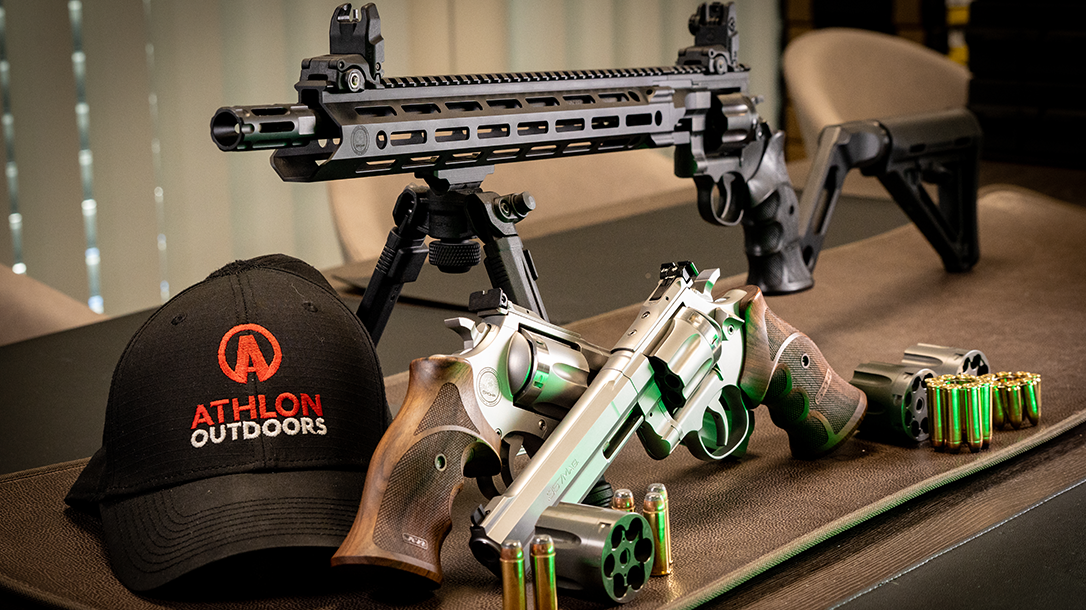
Walking into a factory on another continent to watch people build a product you already love is a strange kind of homecoming. The sounds are familiar, cutters singing through steel, the dry chatter of mills, the soft thump of a lathe spooling up. The cadence is universal, yet the accents around you are not. In Großmaischeid, an hour northwest of Frankfurt above the Rhine River Valley, Spohr’s shop feels both foreign and instantly recognizable. It is a revolver laboratory, bright and clean, organized down to the last fixture, and absolutely focused on one thing, building the most precise hard-use wheelguns they can make.
How I Landed in Großmaischeid To Visit Spohr
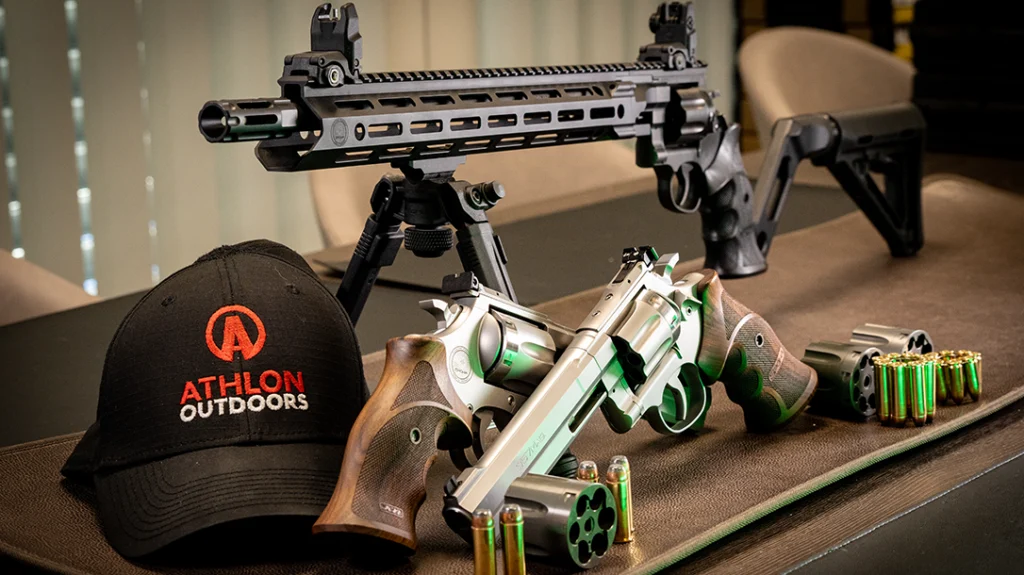
My relationship with Spohr started long before I ever saw the building. At their second SHOT Show I was a brand-new content guy with big curiosity. I made a beeline for the booth, met distributor Jens Busch of B&H Waffenhandel, and told him I wanted to run one of their guns honestly. He could have waved me off. Instead he sent an L562. That gesture mattered. I shot it, wrote about it, produced video on it and that content opened doors for me at Athlon Outdoors. Spohr is a company of revolver people, and they tend to recognize their own across languages and time zones.
Advertisement — Continue Reading Below
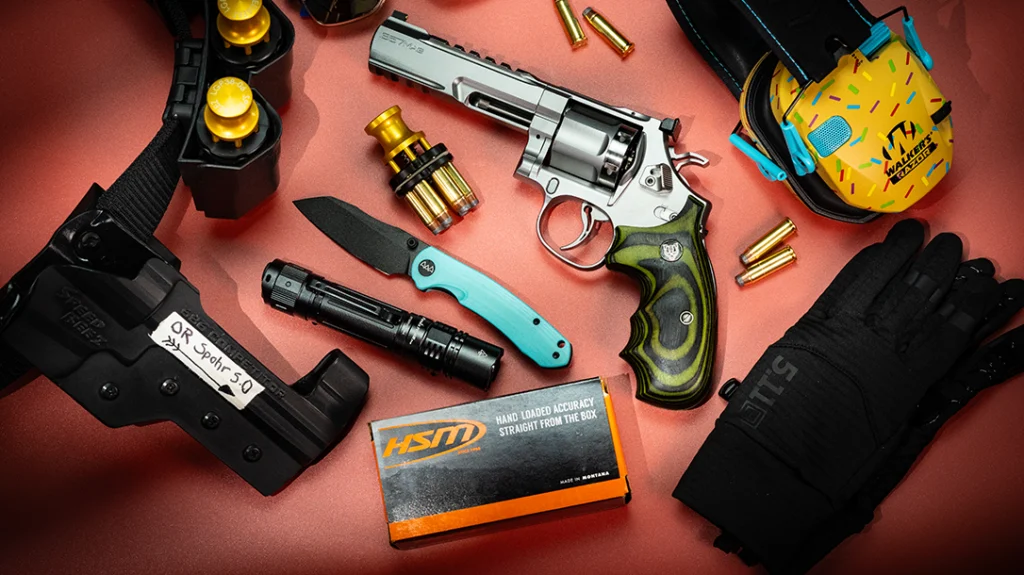
From there, I kept stacking experiences. I put their Club Edition 5.0 convertible into real work at Thunder Ranch during the Defensive Revolver course, three days on the clock, eight hours each day, about 1,200 rounds of .38 Special +P from HSM. I ran the gun dry, no lube, no cleaning, just two wipe-downs with a solvent rag, because that is the kind of test that tells you if a gun is tuned for life outside the soft light of a studio. The result did not feel like luck. The revolver behaved like a machine that had been built to a standard and then held to it.
That confidence took me to Germany. Spohr had already proven to me that they could build an accurate and beautiful revolver. I wanted to see why their guns also carry the third quality that rarely lives with the first two, durability under honest use.
Spohr in Brief, Without the Myth
The short version of the Spohr story looks like this. The guns are built entirely in Germany, not assembled from imported subassemblies. Critical parts are machined from bar stock, which means no MIM in the lockwork. Barrels are cold hammer-forged from carbon steel with polygon-style rifling, then sleeved in an outer shroud that is so seamless you would miss the construction unless someone showed you. Everything else you touch and see is billet stainless.
Advertisement — Continue Reading Below
The triggers arrive refined rather than “good enough until a gunsmith makes them right.” The current catalog centers on the L-frame family, with rimfire, .357 Magnum, and a 9 mm and .357 convertible option, and the new N-frame that launches with .44 Magnum and is slated to include an eight-shot .357 that will also convert to 9 mm. Optics-ready configurations are not an afterthought. Spohr uses an LPA style rear sight on most of their guns leaving the guns pre-cut for optics plates.
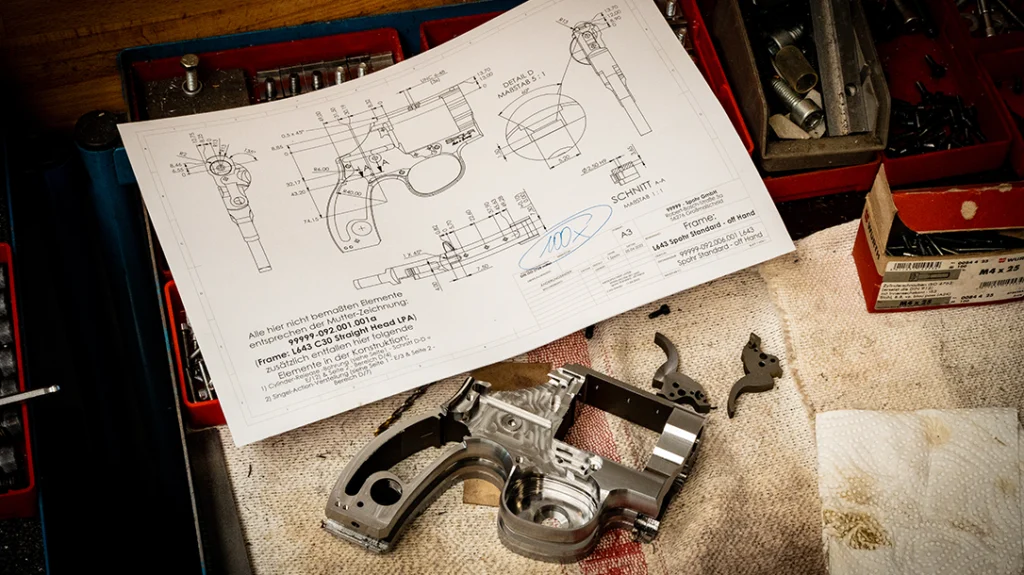
The person at the center of this approach is company founder and master gunsmith Thomas Spohr. He studied at HTBL Ferlach in Austria, which is a serious school for firearms technology, then cut his teeth inside the German Smith & Wesson Club 30 where precision revolver tuning is a craft, not a trend. He started Spohr to build the guns he wanted to shoot. Every decision I watched in the shop flows from that origin story.
Advertisement — Continue Reading Below
On the Floor
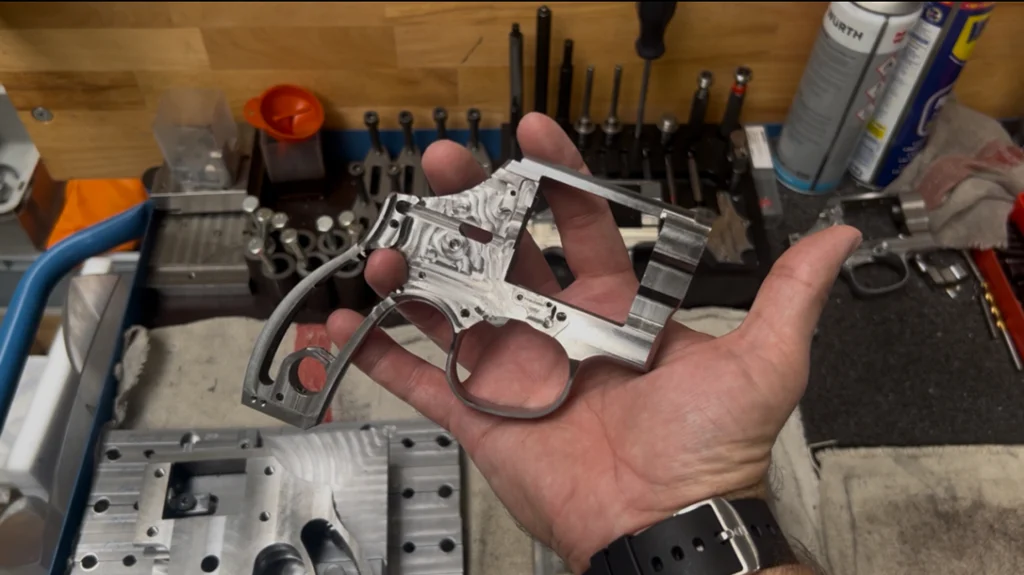
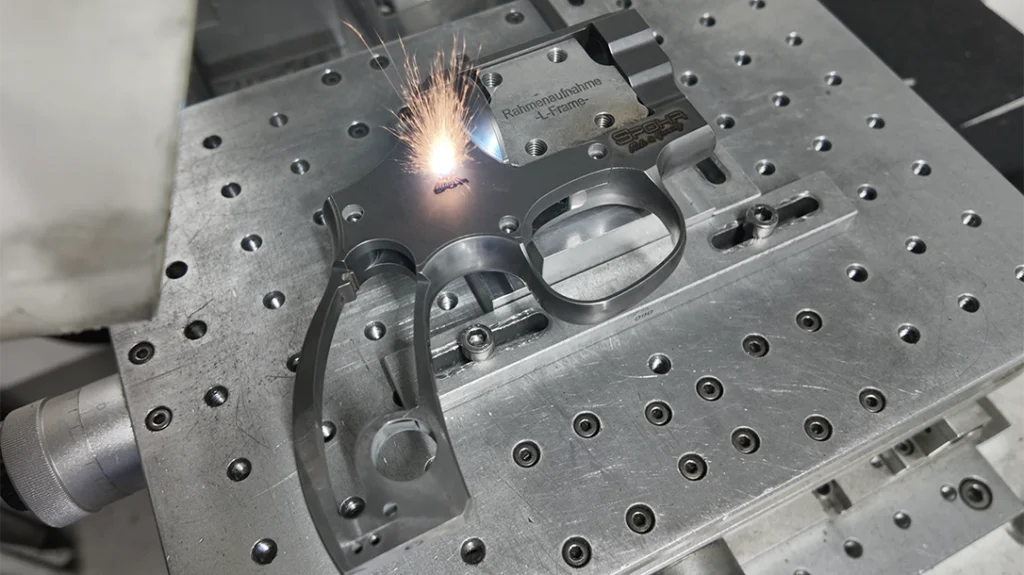
The front doors were rolled open when I arrived, cool valley air drifting over a main floor that hums with five-axis mills, turning centers, and wire EDMs. The machines are modern. The workholding is clever. The floors are clean. You can tell immediately that the cutting side and the fitting side talk to each other all day. Spohr outsources very little, springs and some screws, and that is it. Frames, cylinders, yokes, sideplates, hands, rebound slides, firing pins, hammers, triggers, barrel components, all of it is done in-house. It is not a brag. It is simply the only way to hold tolerances this tight and materials this consistent part to part.
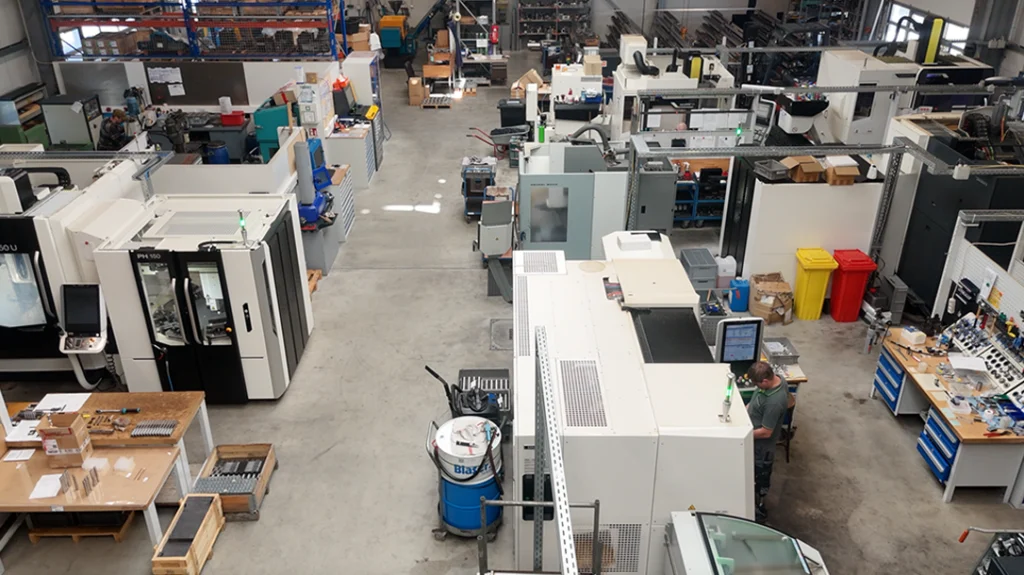
Up a flight of stairs a smaller room holds the benches where fitting and finishing live. This is where the lockwork gets its final polish, where trigger geometry is checked by feel and by gage, and where the faces you see on a website are running their fingertips over real metal. Off to one side are offices and a small R&D space. I watched Thomas step out of that room in the late afternoon with a handful of parts, the posture of a person who still prototypes himself instead of delegating all the fun away.
Advertisement — Continue Reading Below
Why the Guns Feel the Way They Do
Spohr’s barrels start life as carbon steel that is hammer-forged. The rifling’s polygonal form is both accurate and smooth to clean, and it tends to treat lead and plated bullets kindly at the velocities most people run through revolvers. The outer barrel is a shroud that integrates sighting and profile while contributing mass and rigidity without making the gun feel nose-heavy. Everything forward of the frame is designed as a system rather than a stack of parts, which is why the bore axis, sight plane, and forcing cone alignment feel so sorted when you look down the rib.
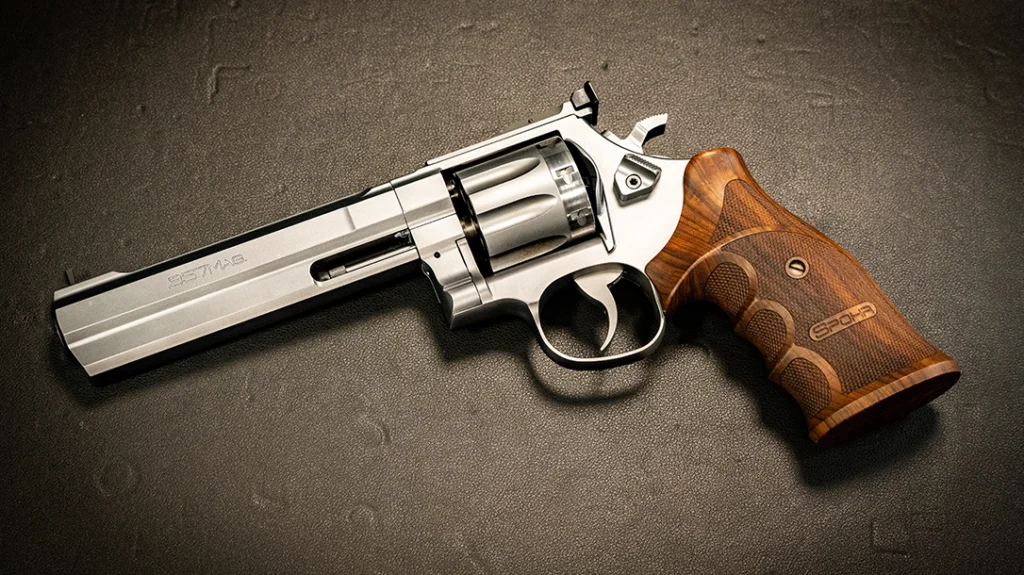
Elsewhere, the material choices are stubborn in the best way. Billet stainless means consistent grain and heat-treat response across every structural part. Wire EDM on internals produces crisp edges where crisp edges matter, sear noses, single-action notches, double-action contact surfaces, and radiused break points where longevity and smoothness demand it. If you have ever looked into a sideplate and wondered why a revolver feels like it is made of watch parts in one hand and pot metal in the other, this is the reason. The Spohr lockwork wears like a well-cut gear train because the geometry and the material support the same goal.
Advertisement — Continue Reading Below
Production Culture & the Night Shift
Spohr’s tempo is not frantic. It is deliberate. They run a healthy schedule, but what impressed me was how they bridge capacity and quality. After dinner one night, a very traditional German meal, Thomas drove us back to the shop. He wanted to reload the machines with raw blanks before heading home. Not because the schedule demanded it, but because he prefers to be the person who feels the workpiece and hears the mills before the lights go out. When those machines cut through the night, they are making critical parts for revolvers that carry his name. He treats that as personal.
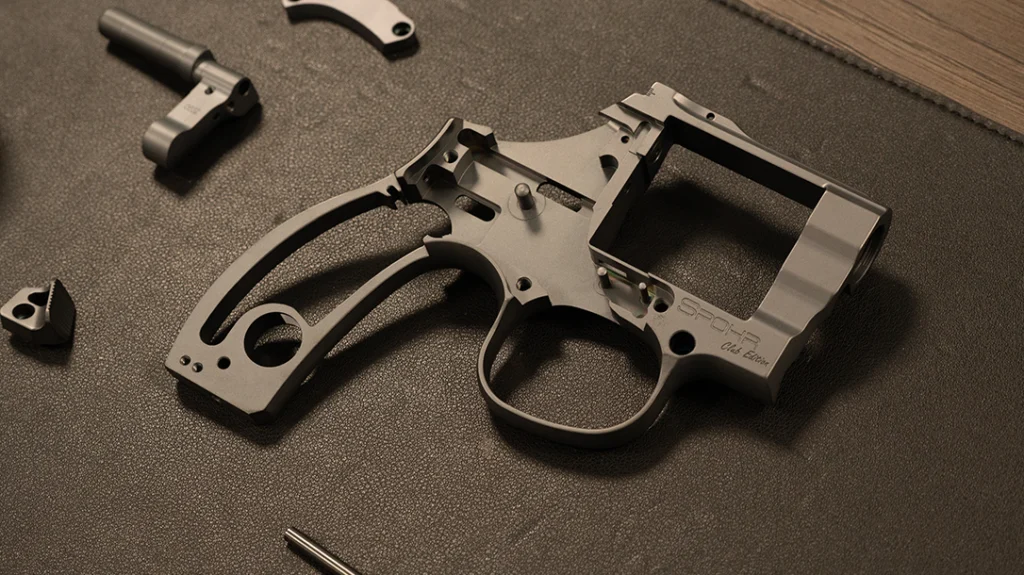
Thomas is looking at expansion. He is not chasing it. More machines arrive when process control and people are ready to keep standards flat while volume goes up. It is a simple philosophy that you can spot in an instant if you have been in enough gun plants. There are places that scale first and fix later. Spohr is the opposite.
Advertisement — Continue Reading Below
The German Context
Germans who shoot live inside a framework that is very different from the United States. Ownership is tied to demonstrated use in the discipline a firearm occupies. The upshot is that you can collect, but only if you maintain a schedule of documented trigger time that proves you are actively participating. Carry for civilians exists in narrow lanes and is, for most people, impractical. That context matters because it shapes what companies build and what shooters ask for. Here it elevates the buy-once mentality. If a shooter will own a smaller number of pistols and revolvers, each one must pull more weight in accuracy, reliability, and longevity. Spohr’s catalog reads like it was written for that customer, because it was. The American market benefits from the same discipline. If you own twenty wheelguns you will still feel the difference when you pick one of these up.
What’s Coming
Spohr’s L-frame platform anchors the line. The rimfire option feels like a proper training and competition surrogate that mirrors the centerfire guns in weight and balance. The .357 Magnum version is the core for most buyers, with a convertible configuration that allows you to shoot 9mm and .357 on the same frame. The N-frame, which is new, opens with .44 Magnum and has an eight-shot .357 on deck that will also take a 9mm conversion. There is more in the pipeline, including designs aimed squarely at American use cases, and a pistol project that has the whole shop interested. Out of respect for their timing I will leave it there. The important point is that growth is planned, not improvised.
The Tour, Up Close
You can learn a lot about a company by watching small tasks. On the main floor I stood by a five-axis as it cut cylinder windows, the machine’s map of the world visible on a big screen, and the operator quietly checking the bore diameter with a gage that had seen careful hands for years. At another station a technician used a wire EDM to cut a complex internal profile with almost no burr to chase afterward, which saves time on the bench and delivers parts that mate correctly from the start. On a worktable sat barrel blanks with their hammer-forging witness, ready for shrouds.
Upstairs a gunsmith stoned a rebound surface with strokes so light the sound was barely audible. That is where a double-action lives or dies. The cues are subtle. If you press a Spohr DA slowly you feel the smooth increase and then a clean, predictable release. That is not a spring trick. It is geometry, surface finish, and consistency across all parts, something those in the industry would call “Aggregate Stack”. Another bench held frames and a cylinders being fitted together, a dance repeated until the fit was right without tension or daylight.
Thunder Ranch Test
I came to Germany already convinced by trigger time. Thunder Ranch is not a place where theory survives without proof. The Defensive Revolver course asks you to draw and reholster to commands for three days, to run reloads when your heart rate is up, and to keep a gun honest in dust, sun, heat and even their infamous Terminator 3 Shoothouse. My Club Edition 5.0 convertible stayed honest. No light strikes, endshake walk or timing drift. It carried its zero. It felt exactly the same at round 1,100 as it felt at round 50. I have broken revolvers at half that round count when the parts were not cut from stock, when the heat-treat was sloppy, when the hand and ratchet geometry felt like they were arguing with each other. The Spohr did not blink.
Value, Do the Math
People ask me all the time why a Spohr costs what it costs. Their least expensive model sits north of three thousand dollars. A new Smith & Wesson 686 runs roughly one third of that. If you stop there, the conversation ends the way you expect. If you continue, you realize you are not buying the same thing.
To bring a 686 to the same level of internal material, EDM-cut geometry, barrel construction, optics provision, and delivered trigger feel, you will spend significant gunsmith time and premium parts and you would only get close. The numbers vary by shop and region, and there is always someone’s cousin who can do it cheaper, but the realistic total often lands around five thousand for a top-tier S&W build, and you will wait while it is done. The Spohr arrives that way in the case and you can shoot it the day it shows up. It is not complicated once you frame it that way.
What Is Hard to Put in a Spec Sheet
Two details stuck with me. The first is Thomas stopping by the machines at night so the next shift, the unattended one, could cut all the way to sunrise without starving. It tells you where his head is. The second is how the people on the floor talk about the work. There is pride, of course, but there is also a lack of drama. Nobody tried to sell me on magic. They showed me methods. They showed me parts. When I asked about surface finishes or fixture stacks or why a particular edge was broken the way it was, they answered in the language of process, not lore.
German Legal Reality
One more piece of context matters for American readers. The German system expects shooters to use what they own in a documented way. It is a discipline that trims collections to match available time, and it discourages impulse buying as a lifestyle. It also reduces the daily carry piece to a rare legal status, which means most of the handgun trigger time here feeds sport and training rather than discreet carry. That shows up in what Spohr prioritizes. Accuracy that holds across thousands of rounds. Triggers that stay where they were set. Frames and cylinders that take steady use rather than a few outings a year. When you understand the environment, the gun you hold makes even more sense.
What Comes Next
Spohr has two frame sizes in production and is growing carefully. The L-frame covers the broadest set of needs with rimfire, .357, and 9mm and .357 convertible configurations. The N-frame puts real authority in the hand with .44 Magnum and will soon host that eight-shot .357 that also plays with 9 mm. More is planned through 2026, 2027, and 2028, including projects that will speak directly to American demand, and a semi-auto pistol design that has people’s attention. None of it will matter if the quality slips, which is why the cadence on the floor in Großmaischeid stays measured. Output is rising, standards are not moving.
The Takeaway
You can buy a pretty gun. Or you can buy a tank. You can buy a race-tuned instrument that wins on a square range and fades when it gets dirty. It is rare to hold all three qualities at once, accuracy and beauty and durability. That is the triangle Spohr is building. If you spend a morning behind their glass doors you understand why. They cut parts from the right materials and finish surfaces where it counts. They assemble and test with the patience that tight tolerances require. Spohr does not pretend their methods are mysterious. They simply do the work with a level of consistency that is hard to fake.
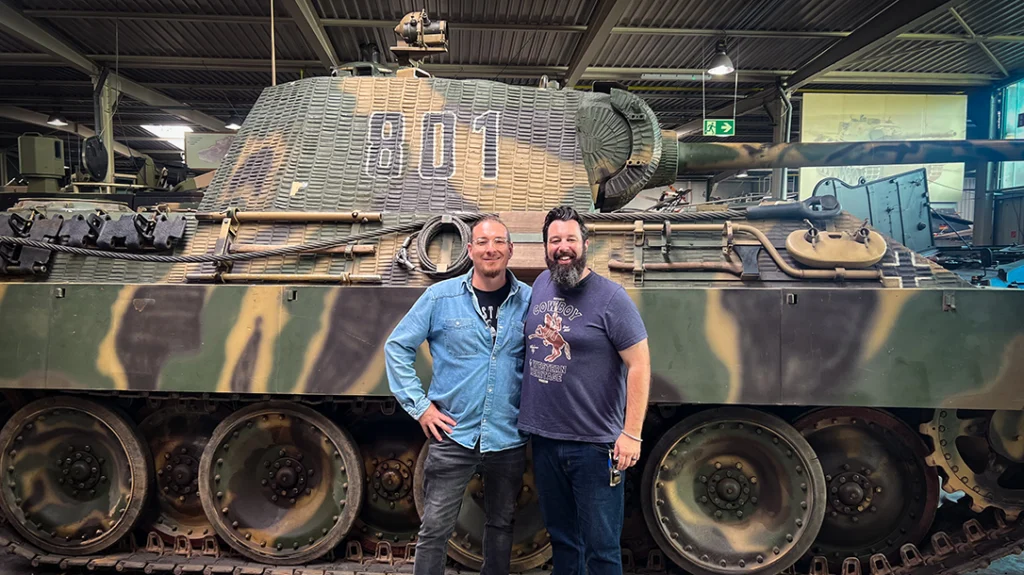
For me the proof loop is closed. I shot their revolver hard at Thunder Ranch and it behaved. Having watched their machines cut and their people fit, and the parts supported what I felt on the range. I talked to the person whose name is on the frame, and his decisions track with the guns he ships. If you get a chance to run a Spohr, do it. Be warned that it might rearrange how you look at the other wheelguns in your safe.