



Images by the author
Let me begin by telling you about my experience with the Super Blackhawk. It was 1979, and I was showing my Ruger Blackhawk .45 Colt to my good friend Mitch’s dad. He was a military collector and had a basement just this side of Wonderful. I loved to go down there… every wall was filled with rifles, pistols, helmets, and other items. He even had a 6-foot-tall mannequin, Herman, decked out in a complete Wehrmacht uniform with helmet, correct in every detail, with a Gewehr Karabiner 98k slung over his shoulder. Herman could creep you out if you weren’t expecting to see him… Pretty soon, he went away. Many museums were jealous.
Anyway, he had an original Ruger Blackhawk .44 Magnum. Not the Super Blackhawk, but the original, before the safety gizmos, the latter New Model ones employed. This was the one built on a slightly smaller frame, without the protective “ears” around the rear sight that the later models had. I truly enjoyed handling that revolver.
I had the .45, as I said. However, I wanted a .44. This was immediately after Dirty Harry, and .44s were the thing to own, not those old-fashioned .45s. I really wanted a Model 29, but at that time there was no way. That movie pushed prices into La-La Land. (I eventually did end up with that 29, and I have a 629 now.)
So, even though I was reminded that the .45 Colt was no slouch as a manstopper, I had to have the double-deuce. I traded the Blackhawk for a Super Blackhawk and got into handgun silhouette competition. I was using Elmer Keith’s load of 22 grains of 2400 powder under a 250-grain hard cast SWC bullet. I practiced with that load until it raised a bone in my wrist, at which point I tamed it a bit by using less powder. I also remember hand-carving walnut grips with a recoil shoulder, which prevented the gun from rolling in my hand. Why I did that, I don’t know… that’s the advantage of the SAA-type of revolver. It rolls with the recoil.
I kept that gun a long while and traded for that 29, if I remember right. The (6)29 (is)/was great, but I was always afraid I was going to bend something by shooting loads through them that the Super Blackhawk ate with regularity.
So, the old Super Blackhawk and I go way back and have been friends for decades.
I was perusing Ruger’s site a while back and stumbled across the SB… I thought, “Why not?” and ordered one to review. I got the shorter-barreled version, the under-five-incher, in stainless. I’ve always wanted to try that short barrel. Both my earlier Rugers had 7.5-inch barrels. I have since owned another .45 Blackhawk with the 5.5-inch tube, but I prefer the shorter version.
The Super Blackhawk… Why?
In this day and age of whiz-bang polymer-framed 9mm superblasters, why do we still need the steam-powered revolver? I’ll tell you why, in one word… versatility.
The revolver has no equal in terms of the types and levels of ammunition it can fire. Don’t get me wrong… I own many semi-autos, and I shoot them. But in terms of one do-all gun, nothing beats a revolver. If I wanted to shoot some lighter loads in a semi-auto (such as when we tried handloading some subsonic .223 loads for my suppressed AR), be prepared to have a single-shot unless you change out springs. The same rule applies to pistols.
In order to shoot those types of loads in a revolver, you simply load them into the cylinder and fire the gun. As long as the bullet exits the muzzle, you’ve got a winner.
The same thing works with bullet types and weights. Some semis are very picky about the types and weights of bullets that they work best with. Not so, revolvers. You can shoot a flat-nosed full wadcutter (like the .358 RCBS mould I own throws) at 600 fps if you desire… the gun will still work as advertised. Try that with most semis, and you will be able to come up with new curse words.
Lastly, I touched on reliability. With many semis, you have a fairly broad range of pressures that will function the gun, but once you step outside those parameters, anything can happen, from the gun just not firing to it coming apart. I’ve had both happen. The revolver, on the other hand, isn’t as picky. From barely-leaves-the-muzzle to elephant-stompers, unless you really overdo it, the gun will still function as intended.
Here’s our sample…
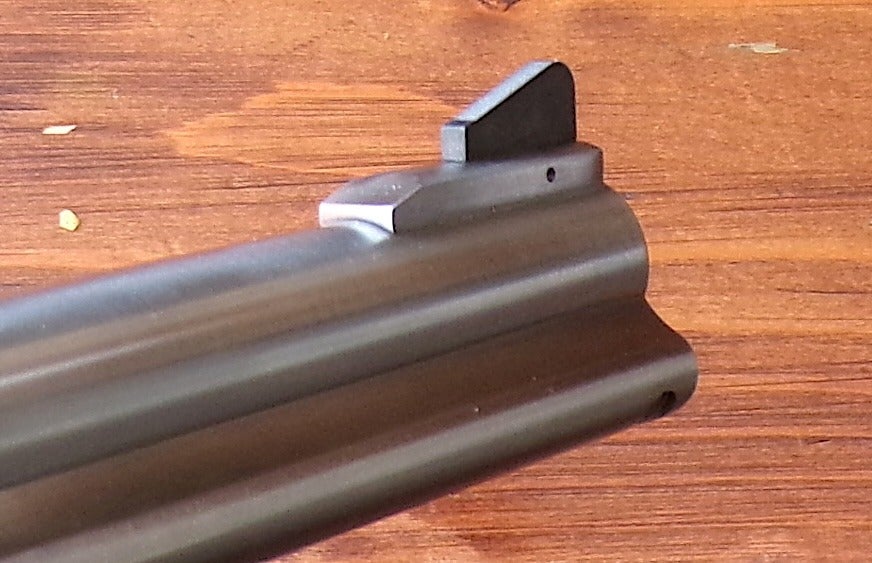
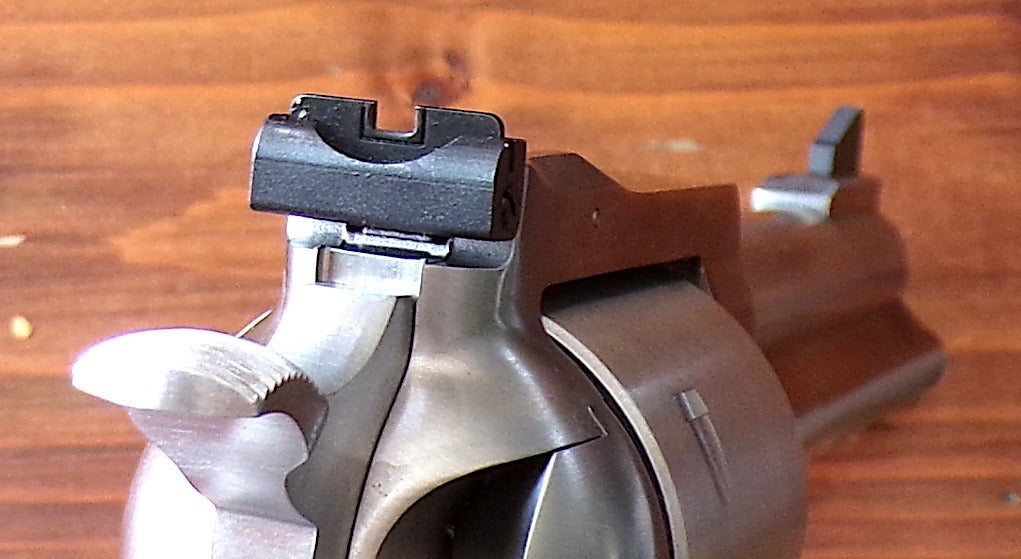
Ruger’s excellent adjustable rear and front post sights haven’t changed since I owned one decades ago. If it ain’t broke… About the only difference is that they don’t put white paint in the rear sight notch outline nowadays, but that’s easily done.
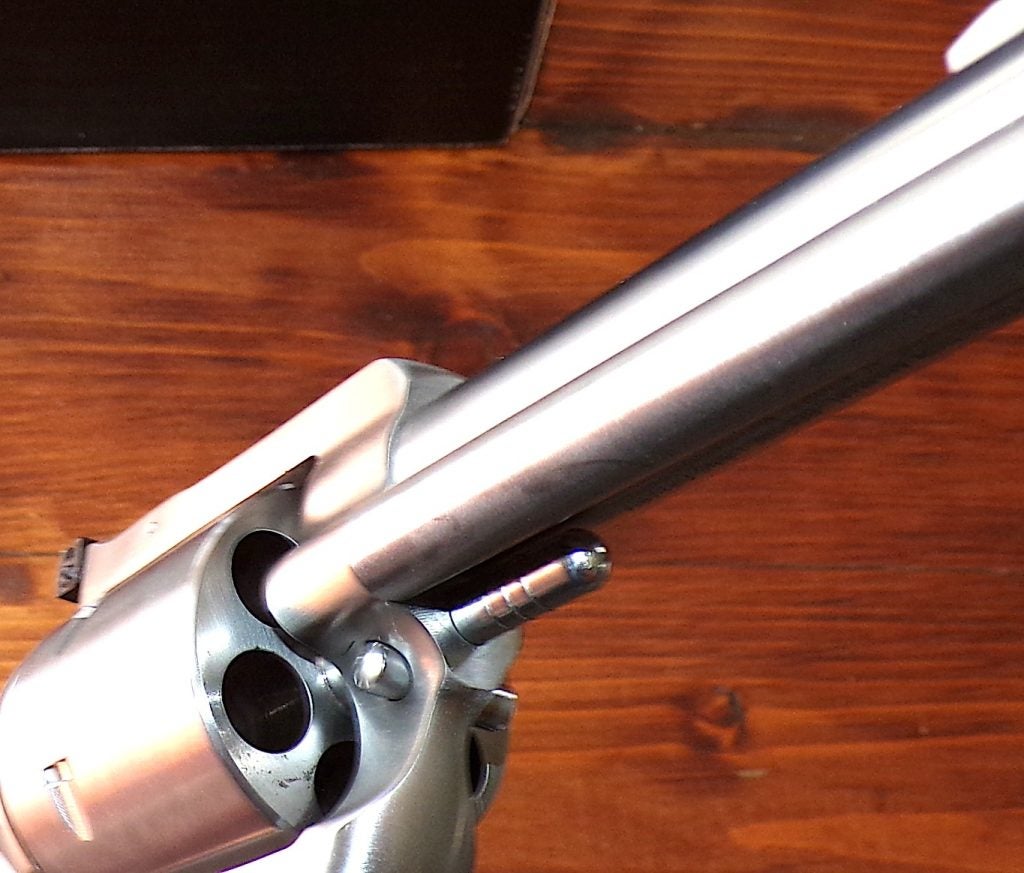
Shiny! This was taken before we blackened the front of the cylinder by shooting the gun.
Range Time
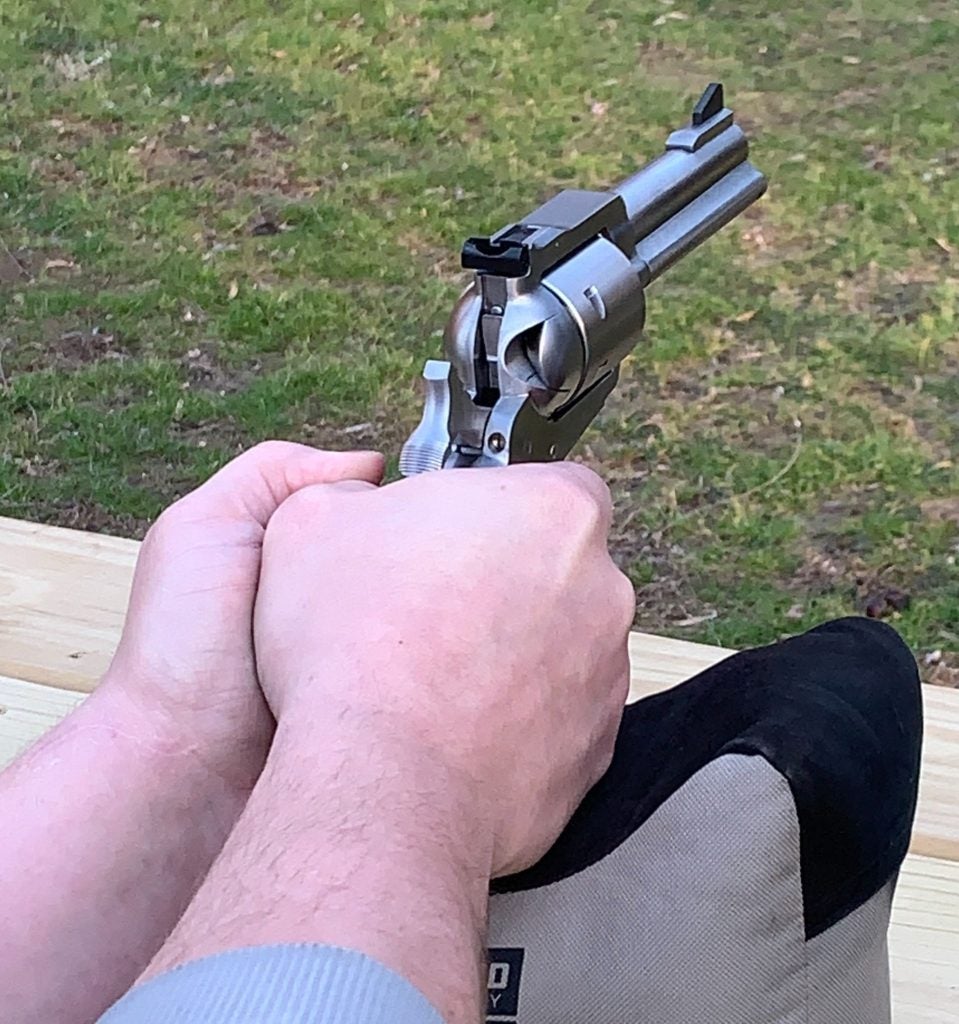
I had two .44 Magnum loads on hand, and one Special variety, all Black Hills. The Magnum loads were a 240-grain JHP and a HoneyBadger 160-grain machined copper bullet.
I also had a 125-grain, .44 Special HoneyBadger load that I used in a recent test of S&W’s new Night Guard 3” .44 Special 5-shot DA revolver. That was one nice gun… look for the review on this site.
Because of time limitations, we didn’t shoot this Special load in the SBH, but it would’ve handled it well and would’ve been more tame in terms of recoil.

Anyway, my oldest son Jesse performed the honors. I tried to shoot it, but my arthritis in my hand acted up, and it hurt after one shot, so he stepped in. We shot 5-shot groups at 25 yards.
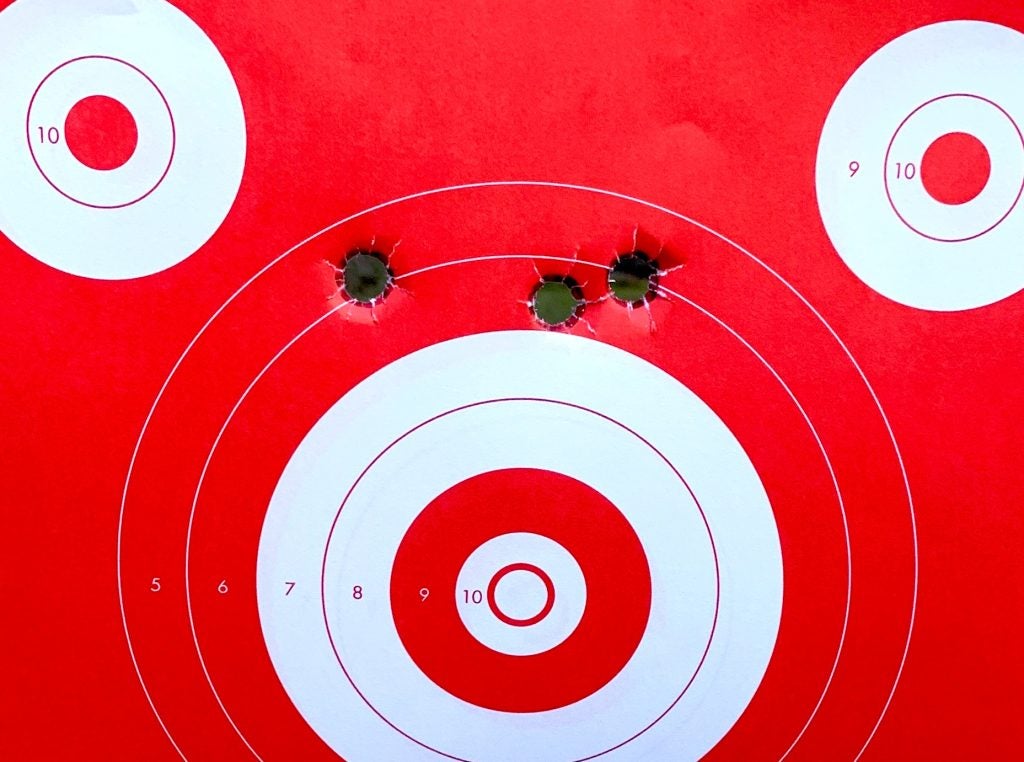
This target of the 240-grain JHP is unique… we see three holes, but he shot 5 times. I wouldn’t think he went over the target, but you never know… at least there are three holes! This was about all the shooting his hands could stand… prodigious recoil!
The HoneyBadger load behaved better:
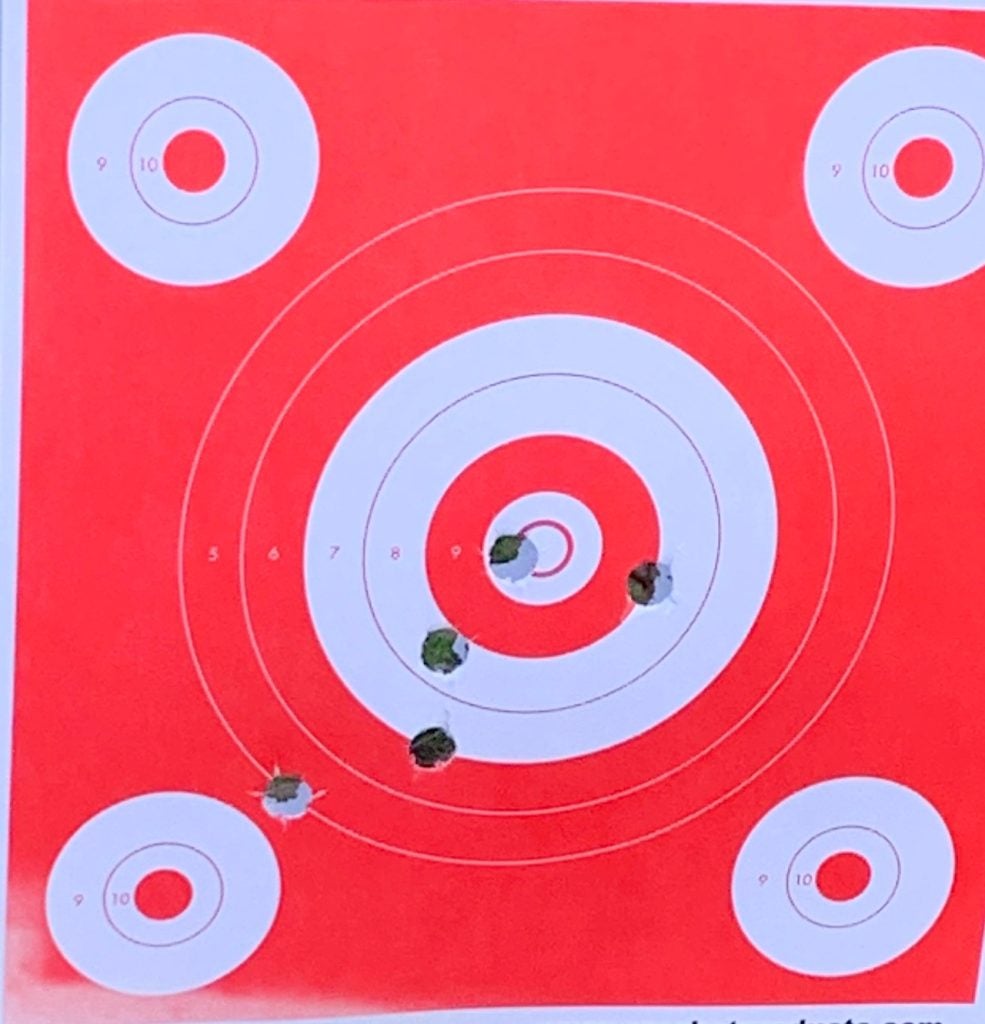
In terms of ballistics, the 240-grain load went 1298 fps, with 898 ft./lbs of energy, and the HoneyBadger’s 160-grain bullet traveled 1594 fps, with 892 ft./lbs of energy. Remember, this is the shortest-barreled (4.6”) Super Blackhawk they make. A longer barrel would do even better. Speaking of barrel length, let’s look at some specifications…
Specifications
- Grips: Hardwood
- Front Sight: Ramp
- Barrel Length: 4.62″
- Material: Stainless Steel
- Capacity: 6
- Rear Sight: Adjustable
- Twist: 1:20″ RH
- Finish: Satin Stainless
- Overall Length: 10.50″
- Weight: 45 oz.
- Grooves: 6
- Available in CA & MA: Yes
- Suggested Retail $1099.00
Conclusion
As I said earlier, I have owned a few Blackhawks and one Super Blackhawk. These guns are the result of technological progress from the early 1873 Single-Action Army revolvers, a culmination of manufacturing techniques, know-how, and materials. You can buy more expensive single-action revolvers, but in my book, there’s no reason to unless you want an exotic caliber.
This revolver would be a useful addition to anyone’s collection who traipses through the woods in search of deer or similar game. Stoked with full-bore magnums, you could take almost anything breathing on the North American continent, and with Specials, have a tame target or plinking session. It is versatile. Just be aware that pushing heavy bullets to extreme velocities will have a reaction… the recoil can be fierce, but the SAA “plow-handle” grip helps tame it as it rolls up in your hand. A longer barrel might help a bit more with recoil, but not much, from my experience. with the 7.5-inch SBH I owned before. I like the 4.6″ length of this barrel… the gun is handy to tote around, but still yields magnum performance.
If you’re in the market for a useful, heavy-caliber revolver, give the Super Blackhawk a look.
Links To Items Used In This Review
- Athlon Rangecraft Velocity Pro Radar Chronograph, $500
- Birchwood Casey Filled Shooting Bags, $40
- Birchwood Casey Eze-Scorer 8 Inch Bull’s-Eye Target, 26 Targets, $9
- Birchwood Casey Range Cleaning Kit, $60
- Black Hills Ammunition
- Caldwell E-Max Low-Profile Hearing Protectors, $33
- Caldwell 66% AR500 Steel Silhouette Target, $127
- Caldwell Ultimate Target Stand, $33
- GPS Medium Range Bag, $150
- MTM Case-Gard High-Low Shooting Table, $160
- Wheeler Spacesaver Screwdriver Set, $22
- Wheeler Trigger Pull Gauge, $88