


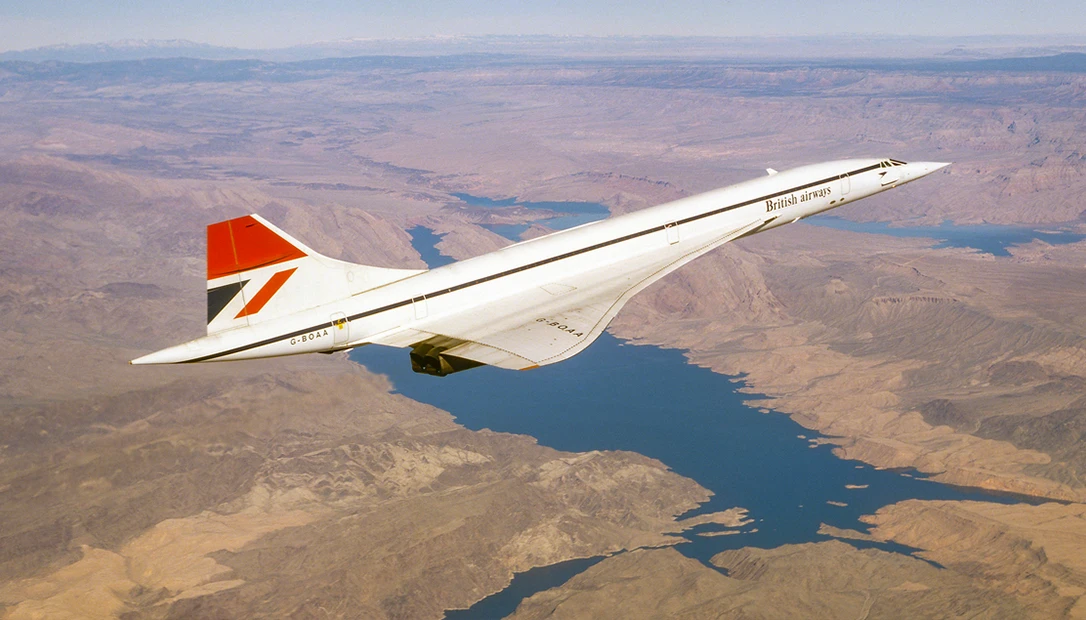
In 1962, while pop culture buzzed about who was on The Tonight Show with Johnny Carson, the UK and France decided to build a plane that would outrun the sunrise. Their partnership, despite a history of polite rivalry, led to the creation of Concorde—one of aviation’s most extraordinary achievements.
Concorde, created under a 1962 treaty and first flown in 1969, was less an airplane than a statement of technological ambition. It could reach Mach 2.04—about 1,350 miles per hour, or twice the speed of sound—demonstrating what aviation could achieve.
The Birth of Concorde
From the outside, Concorde looked like it had slipped through a wormhole from a sci-fi film. It was long, slender, and impossibly elegant, with wings reaching across the sky—almost as if it belonged to the future, ready to help or impress humans. Inside, though, it fit fewer people than you might expect, almost like a tight, exclusive club. Picture about 100 seats and little legroom. Concorde was a fast, impressive jet with the interior space of a compact car. Boarding Concorde felt less like entering a large plane and more like sliding into a narrow, stylish pencil case—small but appealing.
Advertisement — Continue Reading Below
Concorde consumed about one ton of fuel per passenger, making efficiency secondary to spectacle. Dramatic speed took priority over fuel saving.
The sonic boom, Concorde’s signature, enthralled in theory but led to restrictions. Laws banned supersonic flight over land, confining Concorde to transoceanic routes, where it became a symbol for elite, time-conscious travelers.
Advertisement — Continue Reading Below
Flying Concorde was both exclusive and expensive. A round-trip ticket costs about $12,000 in 2026 dollars, putting it out of reach for most travelers. The experience enabled passengers to have breakfast in Manhattan and lunch in Mayfair—a rare privilege that symbolized both speed and status.
The Concorde Crash
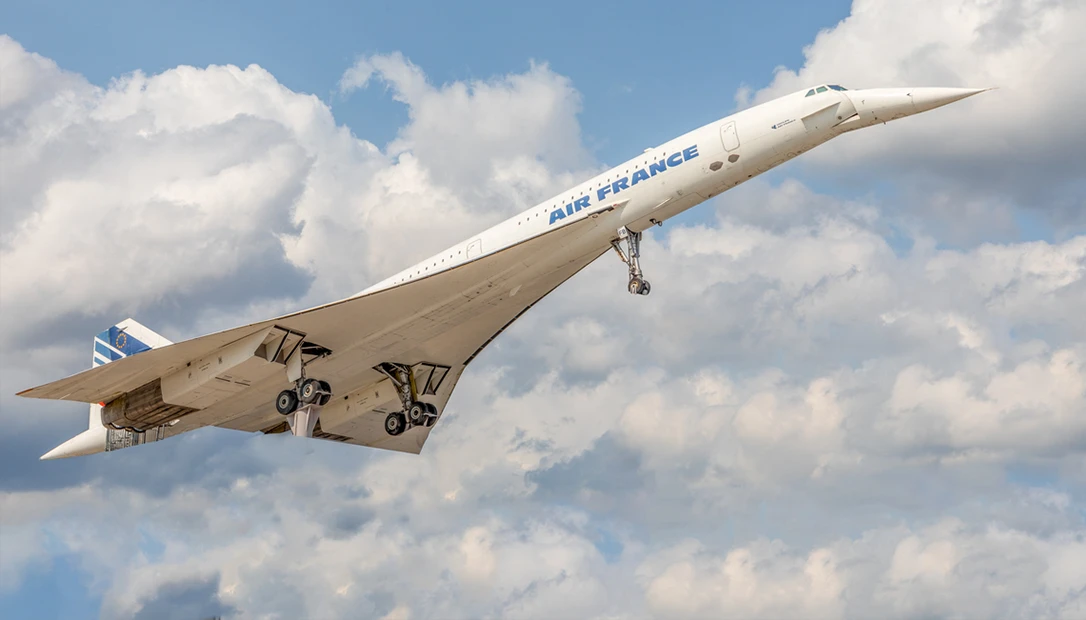
Then came tragedy. On July 25, 2000, an Air France Concorde crashed shortly after takeoff from Paris, killing all 109 people on board and four on the ground. This was a devastating moment for the families and communities affected, as well as for the aircraft itself. Concorde had always seemed untouchable, almost like the Titanic before its sinking—a concept bigger than a machine. Suddenly, Concorde’s flaws and limits were clear, showing that it, too, could meet disaster.
The crash, escalating maintenance costs, and the post-9/11 decline in travel ended Concorde service in 2003. Routine supersonic travel faded, and air travel returned to slower, familiar patterns.
Advertisement — Continue Reading Below
Where Are the Concordes Now?
Of the 20 Concordes built, 18 are now preserved in museums worldwide. In New York City, British Airways’ G-BOAD is displayed at the Intrepid Museum. An Air France Concorde is exhibited at the National Air and Space Museum in Washington, D.C.; Seattle’s Museum of Flight holds G-BOAG (‘Alpha Golf’); the Brooklands Museum in the UK houses another; and France’s Museum of Air and Space displays its own. These aircraft stand today as enduring symbols of human ambition and engineering achievement.
For years, supersonic passenger aviation was viewed as a remarkable, costly experiment. It offered proof of technological capabilities, but also of significant barriers—suggesting such feats might not be sustainable with existing approaches.
But history, like aviation engineers, loves a sequel.
Advertisement — Continue Reading Below
The Return of Supersonic Travel
Enter 2026. The term “SST” (supersonic transport) is dusted off, polished, and reintroduced, not as nostalgic, but as a business strategy. With 130 aircraft already on order from major airlines and manufacturing hubs breaking ground, supersonic travel is no longer a museum exhibit. It’s a production schedule.
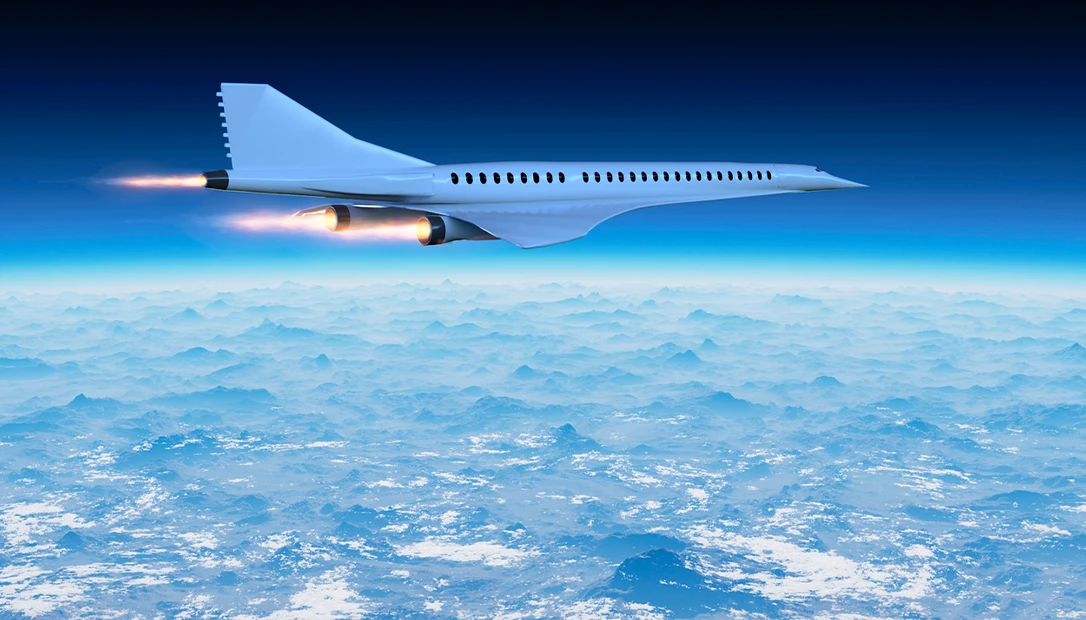
While NASA handles the science—meaning, if it involves speeds like Mach numbers and calculations across multiple chalkboards, NASA is there—Boom Supersonic is building the actual passenger aircraft. Their jet is called “Overture,” which hints at the start of a musical piece and at the beginning of a new chapter in flight.
Advertisement — Continue Reading Below
Boom Supersonic has a clear mission: avoid the “luxury trap” that confined Concorde to the champagne and caviar crowd. Instead of $12,000 tickets, Overture fares are projected between $4,000 and $7,500. Still not pocket change, I mean, I won’t be flying supersonic anywhere, but within striking distance of today’s high-end business-class seats. The goal is not to create a once-in-a-lifetime splurge, but a repeatable corporate upgrade. Think less “bucket list,” more “quarterly earnings call in London.”
Airlines Embracing Supersonic
A New York to London flight in just 3.5 hours for around $5,000? That’s less “James Bond fantasy” and more “aggressive time management.” Airlines like United Airlines, American Airlines, and Japan Airlines have already committed to orders, signaling that this isn’t a speculative sketch on a cocktail napkin. It’s a business plan with signatures.
Advertisement — Continue Reading Below
Technically, Overture is a different beast from Concorde. It trades afterburners, the aviation equivalent of lighting a rocket under your chair, for more efficient medium bypass turbofans in its Symphony propulsion system. Translation: less noise, better fuel economy, and compliance with modern airport standards. It’s designed to run on 100% Sustainable Aviation Fuel (SAF), which means your guilt about climate change can travel at Mach 1.7 instead of Mach 0.85.
Innovations in Aircraft Design
Even the iconic droop nose of Concorde, the mechanical marvel that tilted downward so pilots could see during landing, has been replaced. Overture now uses augmented reality vision systems and high-resolution cockpit displays. Instead of physically lowering the plane’s nose as if it’s peering over reading glasses, pilots use advanced screens that offer better visibility, making the plane lighter and sleeker.
Commercially, Overture is aiming for 64–80 seats, slightly fewer than Concorde’s 100. That’s not a downgrade; it’s a strategy. Higher load factors mean more consistent profitability. That’s business, right? The return customer is what we’re aiming for; longevity is the name of the game in this file, sustainability.
Advertisement — Continue Reading Below
With a range of 4,250 nautical miles, Overture can serve more than 600 global routes. Tokyo to Seattle in 4.5 hours. The New York to Los Angeles route is under 3 hours, in part due to a massive policy shift. In June 2025, a U.S. Executive Order effectively repealed the 52-year-old ban on supersonic flight over land, provided aircraft produce no “audible” sonic boom. That’s not a minor policy change; it’s one of the most significant regulatory shifts in aviation history.
The key is that there is no audible boom. Engineers shape both aircraft design and flight paths so that the shockwaves dissipate in the atmosphere before reaching the ground, avoiding a loud bang. Instead of a thunderclap, people on the ground experience only a subtle air pressure change—barely noticeable.
Supersonic Competitors
There are competitors preparing to enter the market as well. Spike Aerospace is developing the S-512 Diplomate, a business jet without traditional windows. Instead, it offers passengers high-definition screens that display what is outside. This design results in a stronger airplane, better aerodynamics, and avoids disputes over window seats—since there are none.
Advertisement — Continue Reading Below
All of these point to a broader shift. Supersonic travel is being reframed not as a glamorous indulgence but as a productivity tool for corporate travelers who already pay a premium for comfort. A 35–50% price increase for double the speed starts to look less like extravagance and more like math.
The Overture fleet is designed for profitability from the outset. Its Symphony engines are projected to be 75% cheaper to operate than Concorde’s legacy powerplants. At Mach 1.7, it saves about 3.5 hours on transatlantic routes. That time saving allows more daily flights per aircraft, increasing utilization and improving the bottom line. It’s supersonic, yes, but also spreadsheet-approved.
The Conclusion of Supersonic Flight?
So is this the triumphant return of the future? Perhaps. Concorde proved we could cross oceans faster than the rotation of the Earth beneath us. It also proved that speed alone isn’t enough; economics, noise, fuel, and geopolitics all demand a seat at the table.
The difference now is intention. Concorde was a technological moonshot wrapped in elegance. Overture is a business case wrapped in carbon composites. One was a dazzling pioneer; the other is trying to be a sustainable successor.
When Concorde retired in 2003, it felt like a door closing. The sound barrier remained intact, a glass ceiling above civil aviation. Now, with 130 pre-orders and assembly lines warming up, it feels like someone has found the handle again.
If Concorde was the glamorous overachiever who peaked early but left an unforgettable impression, Overture is the pragmatic younger sibling, still fast, still ambitious, but armed with better budgeting software and a quieter personality that his predecessor would envy.
The dream of high-speed civil aviation didn’t die. It just went to the museum gift shop for a while, and if all goes as planned, by the end of the decade, we may once again be strapping ourselves into slender, futuristic jets, watching the ground fall away, and hearing well, ideally nothing at all as we slip past Mach 1 and reclaim a little bit of tomorrow.