


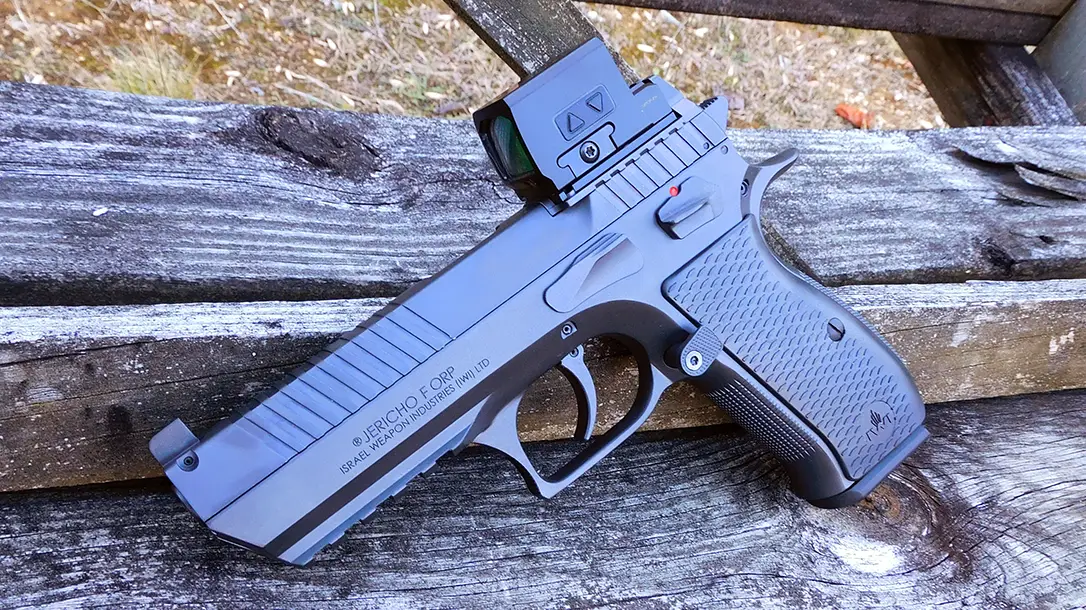
In a world of polymer handguns, there’s something satisfying about a chunk of cold steel. The IWI Jericho 941 has filled that satisfying role for many shooters since 1990. Simply put, the Jericho 941 is big, rugged, and built like a tank. And I mean that in a good way. And now, IWI has taken the platform to the next level with the Jericho 941 F ORP (Full-size Optic-Ready Pistol).
IWI Jericho 941 F ORP
Handgun trends have led to increasingly smaller, lighter, yet more capable sidearms over the last decade or so. However, the pendulum is beginning to swing back in the other direction. The Jericho 941 welcomes that swing and asks, “Where y’all been?”
Many shooters may be reluctant to go full-sized steel. But IWI’s new F ORP model sweetens the pot with new features for curious, hardy souls who want to include this modern warhammer in their system.
Advertisement — Continue Reading Below
Despite the old nickname of “Baby Eagle,” the Jericho 941 is not related to the Magnum Research Desert Eagle. Israel Military Industries (now Israel Weapon Industries, or IWI) marketed both the Desert Eagle and the Jericho 941. The latter’s similar profile, but smaller size, led to the name as a marketing device. Mossberg also sold a Jericho 941 as the “UZI Eagle,” obviously playing on the famous Israeli machine pistol.
But the Jericho 941 is based on the excellent CZ-75, not the gas-operated Desert Eagle. And it has nothing to do with the UZI other than its Israeli origin. The “941” designation refers to the original Jericho pistols, which were chambered in 9mm and .41 Action Express. .41 AE never took off, so most of those guns are chambered in 9mm.
Advertisement — Continue Reading Below
IWI kindly sent me a new Jericho 941 F ORP for testing. Here’s what I found. IWI offers other Jericho 941 configurations, but this review will focus on the gun I have in hand.
IWI Jericho 941 F ORP Features
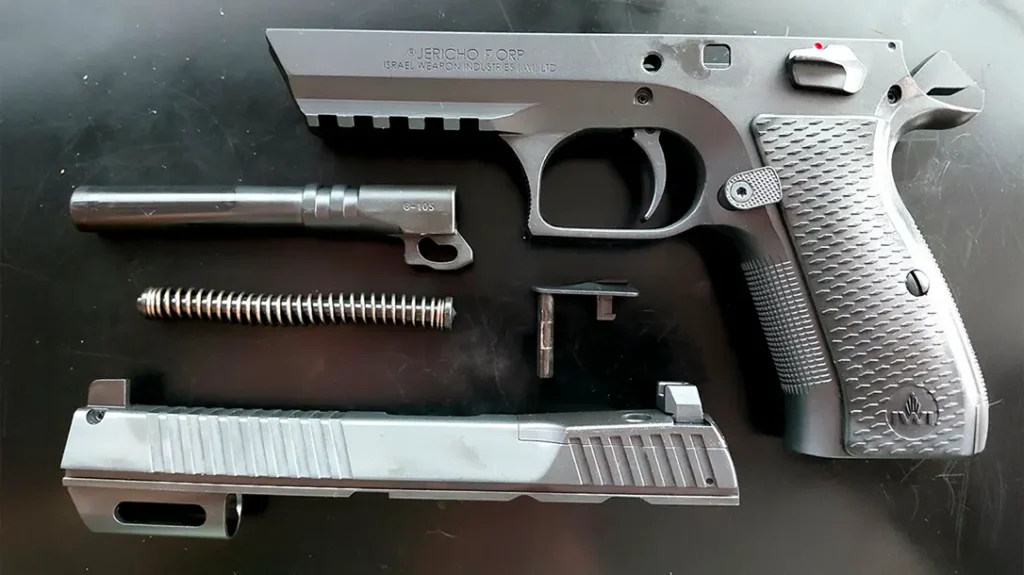
Starting at the top, the CZ-75’s influence is clear. The tapered, low-profile slide uses internal slide rails to provide a lower bore axis than comparable large, steel-framed handguns like the Colt 1911 and Beretta 92FS (30mm vs. 33.8mm and 35.5mm, respectively). Disassembly is also essentially the same as the CZ-75, using the slide release as a takedown pin. The process is simple.
Advertisement — Continue Reading Below
The steel frame includes a generous beavertail to prevent hammer bite, and a beveled front to ease holstering. Stippling on the grip panels provides a firm 360-degree grip without being overly aggressive. Likewise, the slight palm swell fits nicely in the hand.
The double/single action (DA/SA) trigger is pretty good. However, the DA pull is long and heavy without any kind of wall, which really isn’t unusual. The pull is heavier than my trigger gauge could measure, and it feels like it’s in the 12-lb. range.
The half-cock trigger, which is my preferred way to carry a DA/SA pistol, is a smooth, consistent 7 lbs. It can be staged, though the break is still rather long, requiring the shooter to pull all the way through.
Advertisement — Continue Reading Below
The single-action trigger for follow-up shots averages a very light and clean 2.25 lbs. Finally, the responsive thumb safety allows the Jericho 941 to be carried in “Condition 1,” or “cocked and locked,” if you like that method and have the training.
What’s New?
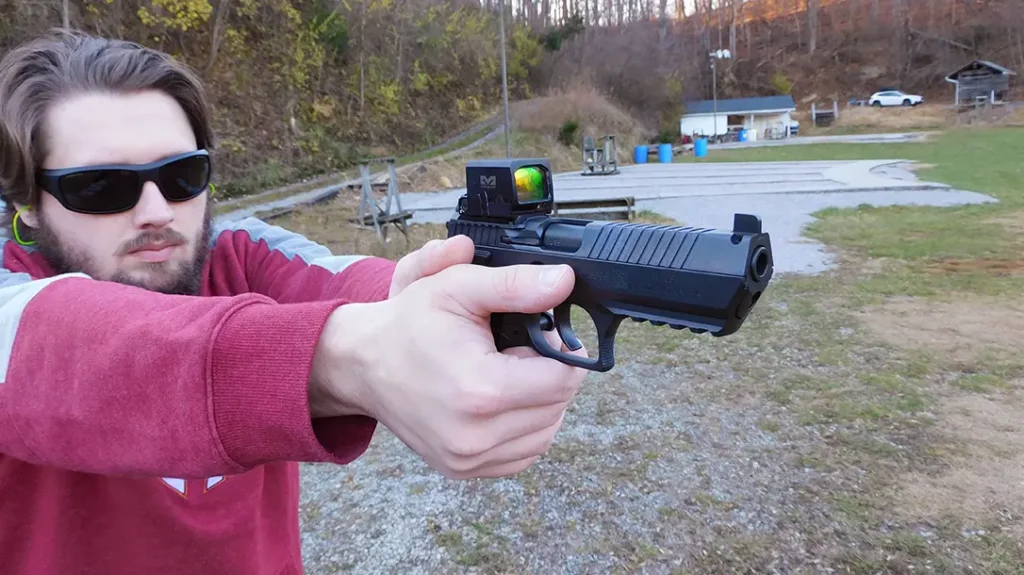
The Jericho 941 F ORP has several new features, making it even more capable than before. Its optic-ready slide is the most obvious and includes plates for RMR- and DeltaPoint Pro-footprint optics. The tall front and rear sights make co-witnessing easy, and each plate includes a milled rear sight notch. IWI includes the necessary Allen wrenches and screws.
Deep front slide serrations ease the challenges of manipulating the low-profile slide, which does require some practice. The improved captured recoil spring assembly is more robust than the old spring and guide rod.
Advertisement — Continue Reading Below
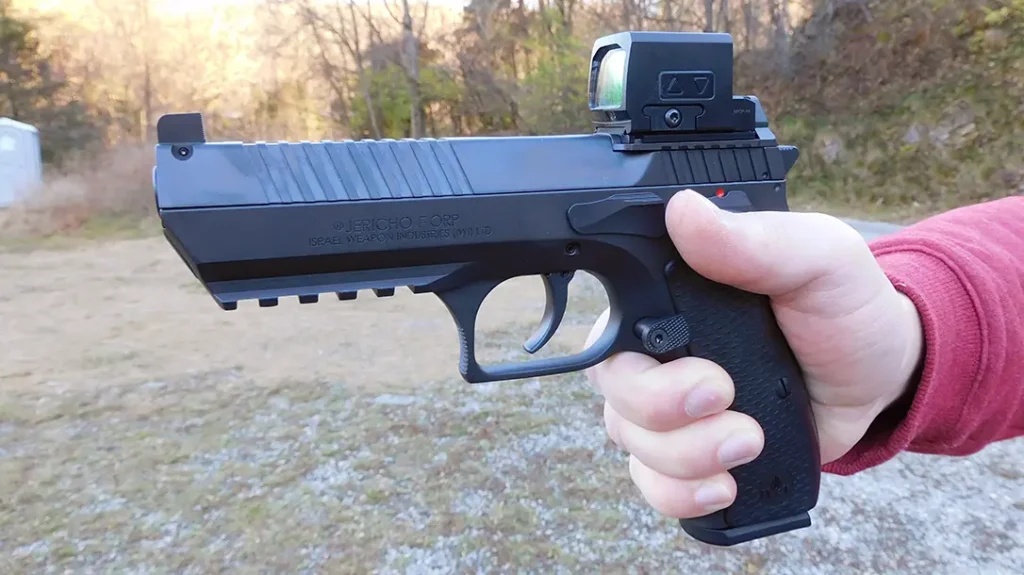
As noted, the 360-degree grip texturing is not overly aggressive, but it’s more so than the older Jericho 941 models. I’d say they struck a fair balance. The frame-mounted safety is now ambidextrous and enlarged on the left side. In addition, the larger 1913 Picatinny rail can easily handle any compatible accessory.
Apart from the optic cut, the most noticeable change is the enhanced magazine release. The textured button is larger and more prominent, making for easy and positive mag ejection. While the button is reversible, its intricate nature requires a competent gunsmith or armorer.
Advertisement — Continue Reading Below
The Jericho 941 F ORP on the Range
As you might expect, the heavy Jericho 941 is easy to shoot, assuming you can run the DA/SA action. I’ve learned that assuming modern shooters know how to run a DA/SA gun is a mistake. If you don’t, consider making the time and effort to learn. It’s a useful skill, and many handguns, including revolvers, are DA/SA.
The weight makes for a light felt recoil, and the gun is very accurate, not least because of the recoil. The large frame allows a very positive grip, which also contributes to accuracy.
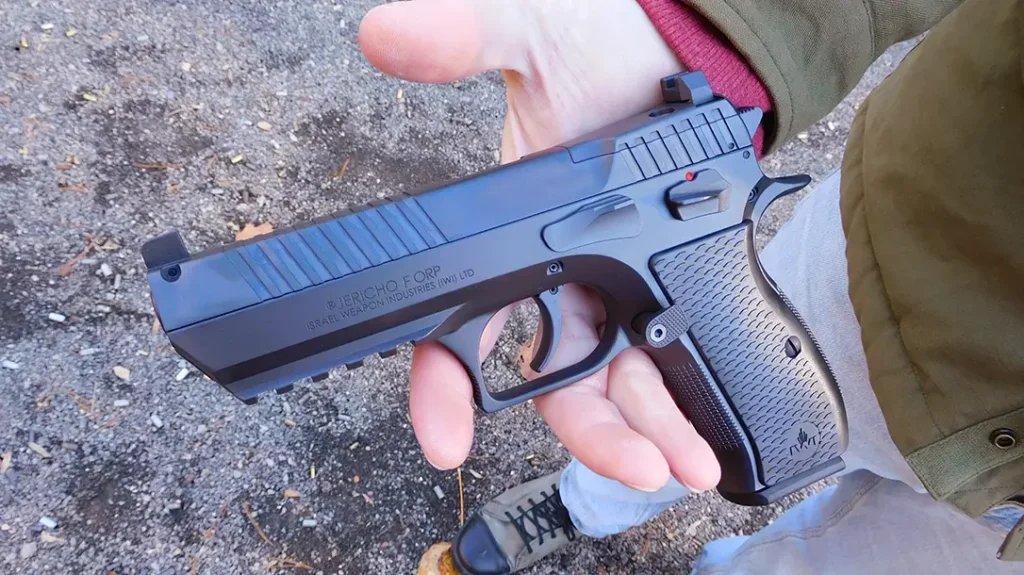
One thing I like about large-framed handguns is that I feel like I have plenty of room to manipulate the controls. Smaller pistols sometimes require me to shift my grip just a bit, but not this gun. The slide release is a bit of a stretch for my thumb, thanks to the intervening safety, but that’s it. I usually manipulate the slide manually anyway, but it’s worth mentioning.
The sight system is good, with the taller front and rear sights to go along with an optic. But I wish IWI had included a visible dot on the front sight. Both front and rear are blacked out, and the front blade can be difficult to see against certain backgrounds. I intend to fix that issue with a drop of luminescent paint, but I think it should already be there.
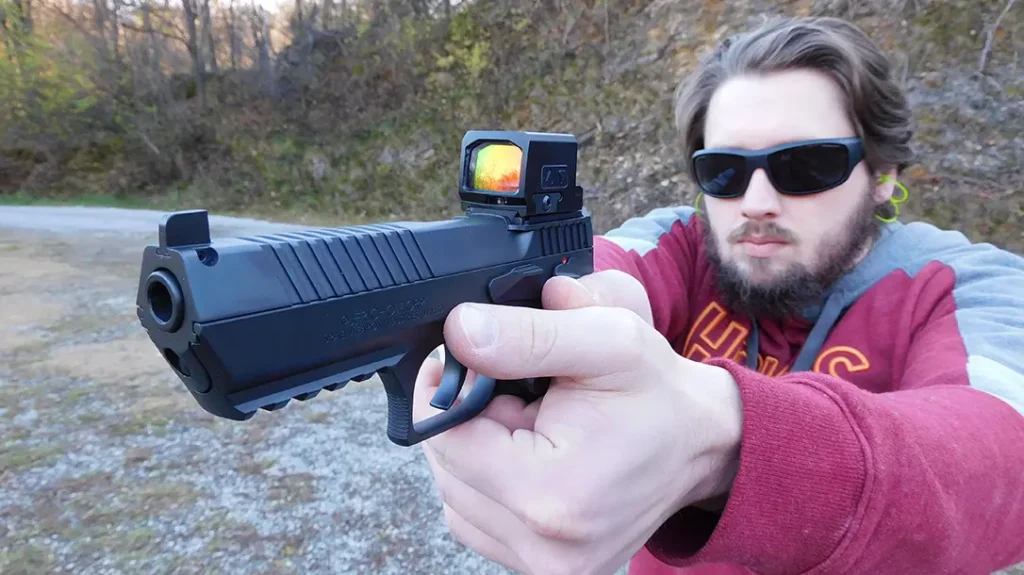
The optic plates are steel, and they fit snugly into the cut for a solid lockup. I attached a closed-emitter Meprolight MPO Pro-F red dot because a gun built like a tank needs an optic with similar characteristics. It was a good choice. The optic increased my accuracy and made the Jericho 941 even more capable in my hands.
Accuracy
My co-tester and I ran the Jericho 941 hard, running drills and more than a couple mag dumps. We had some 115-grain Federal American Eagle FMJ and 115-grain Blazer Brass FMJ, generously provided by Ammo-to-Go. So, we took full advantage. We burned through 450 rounds over three range trips without a single malfunction. This gun is rock-solid.
It’s also very accurate. We ran the local police department’s qualification drill and smoked it. The Jericho 941’s stability is a real plus when firing fast shot strings. It’s not a race gun by any stretch. However, the short reset and light SA trigger make for fast follow-ups, especially with the light felt recoil. We both scored max points, running the 50-round drill twice. The gun performed equally well on the dueling tree and Bill Drills.
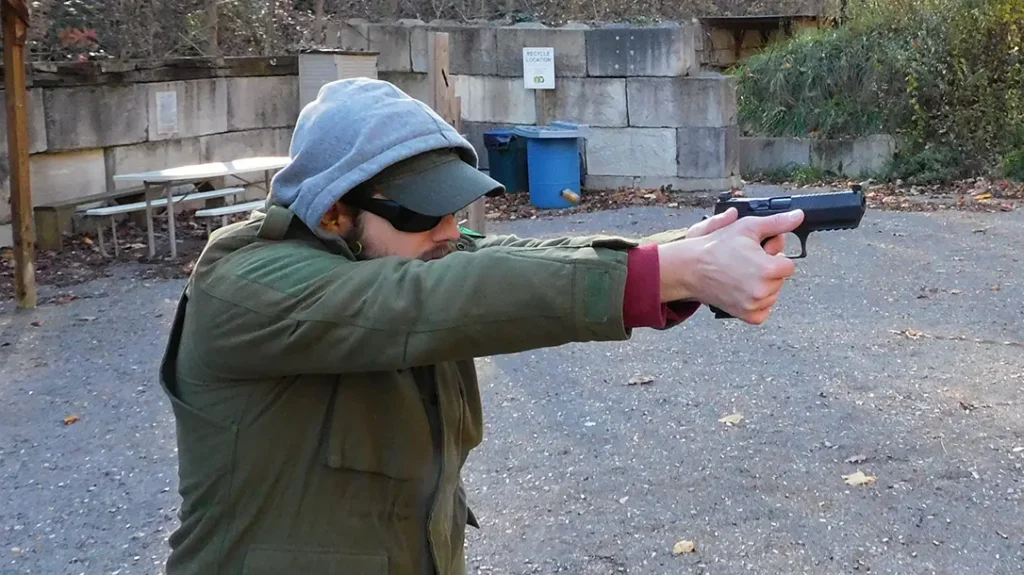
Running that qual drill required a good holster, and we found one in the Bianchi Model 126 GLS Assent OWB. I also carried the Jericho 941 using that holster, which I’ll address momentarily.
Running that drill with the holster’s retention lever required moving it to the 3 o’clock position on my belt. I couldn’t effectively operate the lever with my middle finger at my customary 4 o’clock spot, which also affected how I carried it. Once I got the holster position right, the operation was smooth.
Carrying the IWI Jericho 941
This is a heavy gun, weighing in at 38.6 ounces, not including the ammo. But a good holster like the Bianchi can mitigate that, and it did to a point. The Jericho felt fine walking around underneath a light jacket. Just make sure you have a good carry belt that won’t sag. My go-to is the Blackbeard G2 Ranger Advanced EDC Belt. I knew the gun was there, but it wasn’t a big deal.
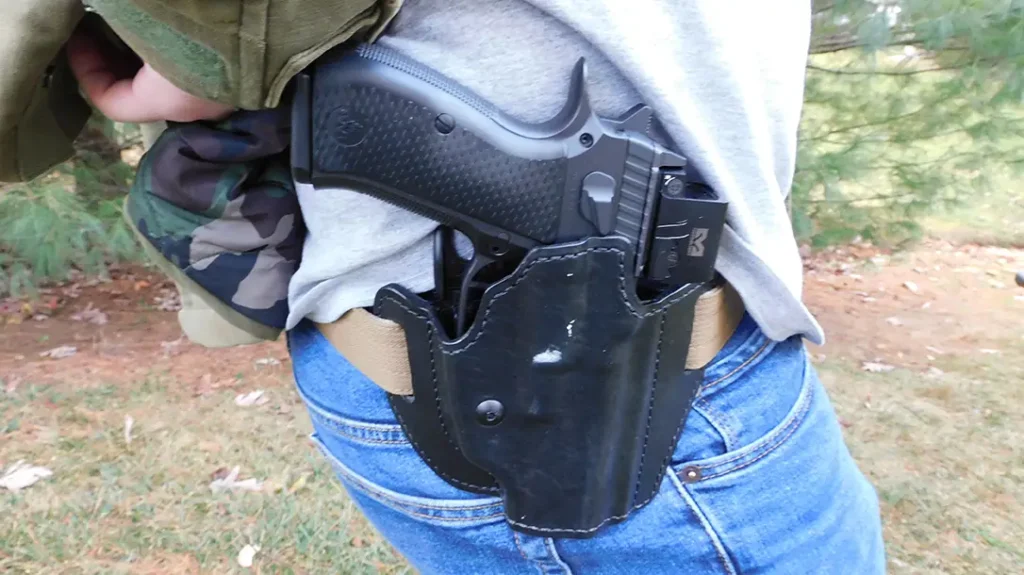
The big Jericho was less comfortable when driving, for obvious reasons. I said it’s built like a tank, and that becomes apparent when fastening your seat belt. Even so, it was doable.
My range experience with the holster’s retention lever was a lesson well-learned, and I carried the Jericho at 3 o’clock. That made it a bit more obtrusive than my normal carry method. However, my draw operation is much smoother and surer that way.
I don’t see myself carrying the Jericho concealed very often, but I think it will be awesome on a battle belt when I get the gear for that setup.
The IWI Jericho 941 F ORP Offers Well-Needed Upgrades
I really like the Jericho 941 F ORP. I decided about a year ago that I would no longer buy new semiautomatic pistols that aren’t optic-ready. My eyes aren’t what they used to be, and I clearly shoot better with an optic.
Buying a new handgun without that capability seems like a waste of money these days. Some of you may be the same way. I’ve wanted a Jericho 941 for a long time, but I’d decided against buying one.
IWI has now fixed that problem with the new F ORP model. That one upgrade means the Jericho 941 will enter my system once I find a battle belt holster for it. I might even carry it occasionally, depending on the situation.
I love the Jericho 941’s ruggedness. Not that my other system guns aren’t very capable. But sometimes I want steel, even if I can’t really articulate why. I just like it. That same desire also prompts me to sometimes carry a Colt revolver. The Jericho is just one of those guns I like to handle. Like I said in the introduction, it’s satisfying.
The Jericho 941 performs, and its track record shows its toughness and durability. IWI didn’t change any of that. They just added some features that modern shooters want. I’m here for it. Maybe you will be too. Sometimes, a hammer is just what you need.
IWI Jericho 941 F ORP Specs
| Caliber | 9mm Parabellum |
| Magazine Capacity | 17+1 (10-round magazines available) |
| Barrel Length | 4.4 inches |
| Overall Length | 8.2 inches |
| Weight | 38.6 ounces (Without magazine) |
| Action | Double/Single Action |
| Optic Ready | RMR and DPP Plates |
| Frame | Steel Frame |
| MSRP | $719.99 |