


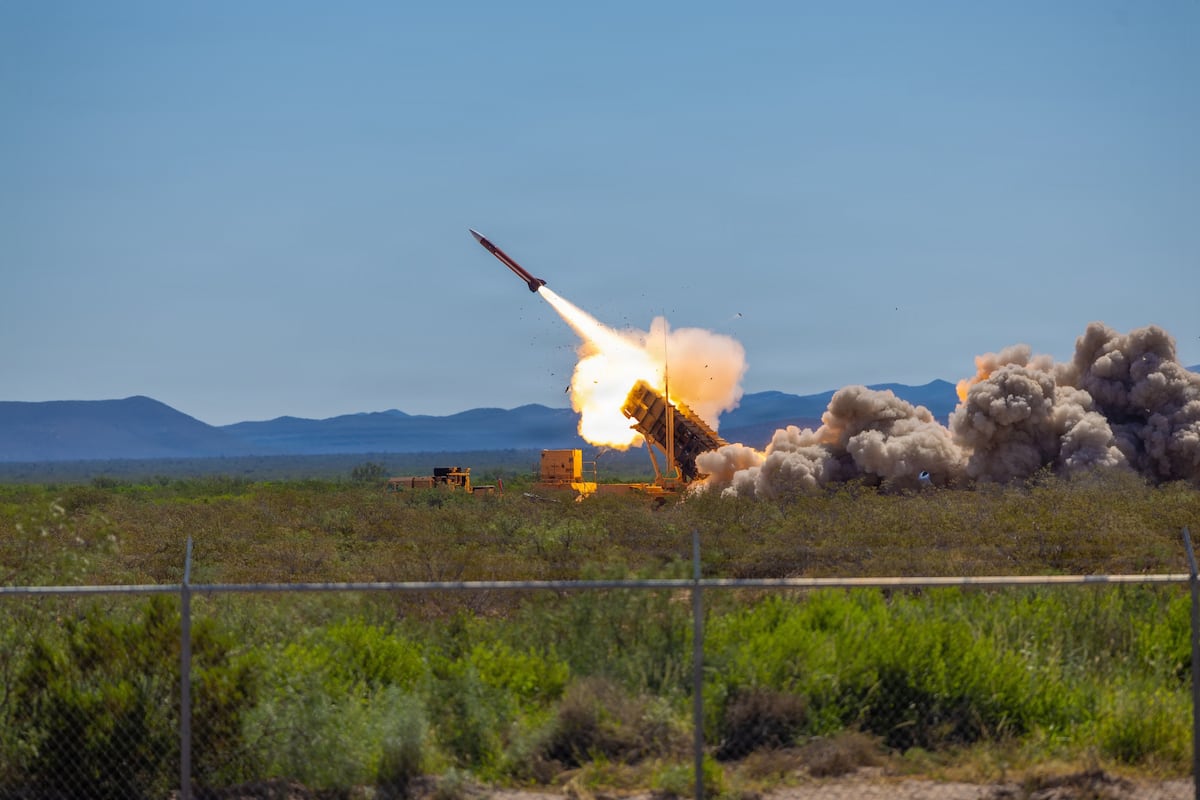
As missile and drone attacks intensify across the Middle East, U.S. forces are leaning heavily on air defense systems like the Patriot missile battery to intercept incoming threats.
The Patriot system is widely used to defend against incoming missiles and drones using radar and interceptor missiles — such as the Patriot Advanced Capability-3, or PAC-3, interceptor — to engage incoming threats.
The system has become a key tool for protecting bases and infrastructure from aerial attacks, but at a high cost. PAC-3 interceptor missiles cost millions of dollars each, making them especially expensive when used against cheaper threats like drones.
The tradeoff has put new focus on how the system is used in practice. Here’s how it works from detection to interception.
Detection
A radar sweeps the sky, scanning for anything out of place. Within a Patriot battery, that radar is designed to track aircraft, missiles and drones across a wide swath of the horizon to build a picture of the airspace in real time.
When an object appears in the airspace, the system locks in and begins calculating its speed, altitude and trajectory as it moves. Using that data, the system works to identify the object and discern if it is a threat.
It computes where the object is heading, and if it seems likely to hit a protected area, like a base or population center. That assessment sets the stage for what comes next: a decision on whether or not to engage.
Launch
Once a battery is ordered to engage, a Patriot launcher fires an interceptor missile toward the predicted intercept point. The PAC-3 speeds up after it is fired, shooting into the air and then turning toward a target based on data from the radar.
As the missile soars, it keeps receiving updates and can adjust its path as it closes in on an object.
Interception
In its final moments, a PAC-3 interceptor missile rams directly into its target.
Instead of exploding nearby, the PAC-3 uses a hit-to-kill method, destroying the incoming threat by colliding with it at a high speed. That makes this particular interceptor missile critical for ballistic missile defense, where precision is crucial.
A layered defense
Patriot systems are one part of a layered air defense. Terminal High Altitude Area Defense, or THAAD, systems, also manufactured by Lockheed Martin, are designed to intercept ballistic missiles inside or outside the atmosphere and earlier in flight, while the Patriot operates closer to the ground.
Like the Patriot system, THAAD uses a hit-to-kill method and relies on radar and interceptor missiles. Because THAAD can operate at higher altitudes and over a wider area, one THAAD battery can cover larger regions.
The cost
Each PAC-3 interceptor cost millions of dollars, making it an incredibly expensive tool to use against drones that cost a fraction of that price to manufacture. Though Lockheed Martin, the interceptor’s manufacturer, is poised to ramp up production under a January agreement with the Pentagon, as it stands, the U.S. has a finite number of PAC-3 interceptor missiles and production takes time.
As interceptors are consumed in the Middle East, experts warn supply may not keep up with high — and expensive — demand.
Eve Sampson is a reporter and former Army officer. She has covered conflict across the world, writing for The New York Times, The Washington Post and The Associated Press.