


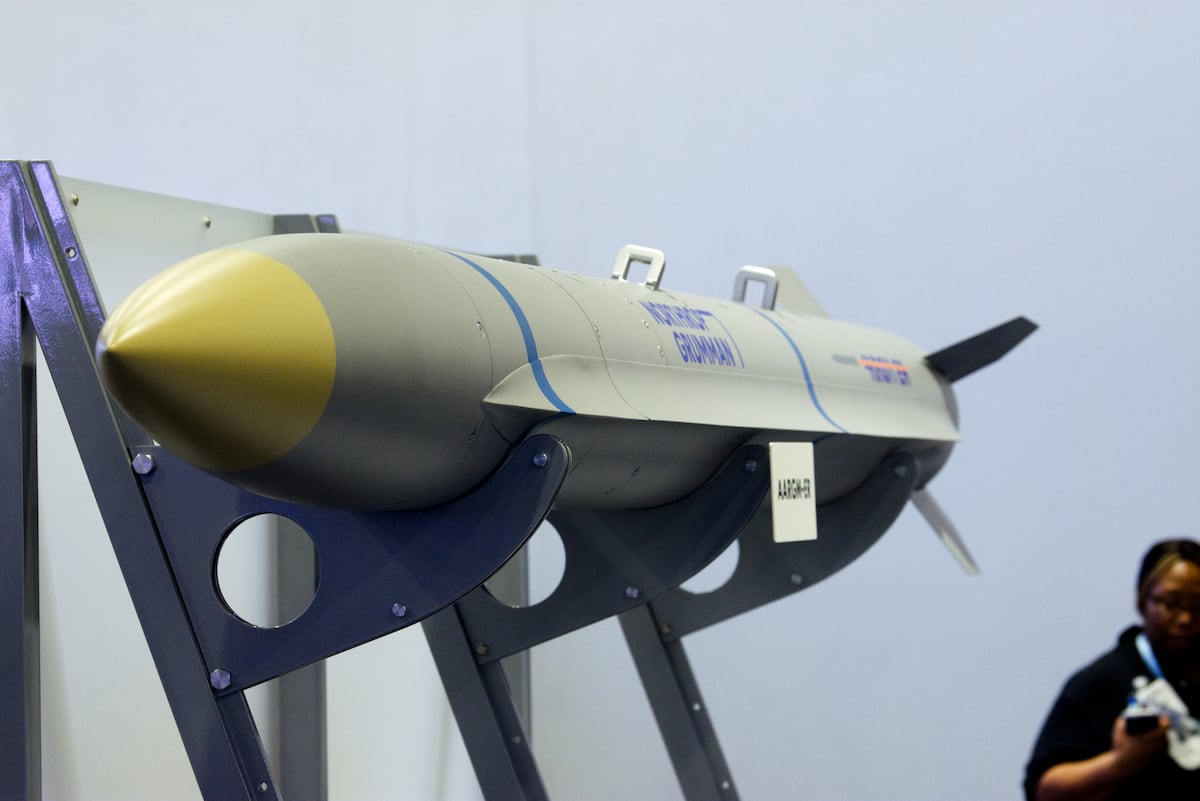
The U.S. Navy wants to a new anti-radiation missile with a longer range than existing weapons.
The Advanced Emission Suppression Missile, or AESM, “must be compatible with existing launch platforms (e.g. F-18, F-35) and infrastructure currently supporting the Navy and Air Force’s existing inventory of anti-radiation guided missiles,” according to the Navy’s Sources Sought notice.
The Navy expects to order up to 300 missiles per year, with the weapon intended to be fielded within two years after the contract is awarded, according to the announcement.
The notice does not specifically mention replacing the existing AGM-88 High Speed Anti-Radiation Missile, or HARM, which was first fielded in the 1980s and is being used today by Ukraine. Nor does it mention the new AGM-88G Advanced Anti-Radiation Guided Missile Extended Range, or AARGM-ER, which is now undergoing live-fire testing.
However, the notice does call for an anti-radiation missile “with a longer range than existing in the Navy’s current inventory.” The HARM has a range of up to 80 miles, depending on the launch aircraft’s altitude. The AARRGM-ER is estimated to have a significantly longer range.
The Navy seems concerned that its next-generation anti-radar missile should be able to target modern radar systems that are designed to minimize vulnerability to anti-radiation weapons.
It should have a seeker with broad frequency coverage, GPS and INS guidance plus alternate navigation that can function despite jamming, and the ability to engage targets in the air as well as on the ground, according to the notice.
The AESM should also have “potential for pre-emptive targeting capabilities,” the Navy said.
The weapon is intended to be mounted on existing aircraft such as the F/A-18E/F, EA-18G and F-35. Open architecture will allow it to be launched by future aircraft models.
The AESM’s Technology Readiness Level must be at least TRL 7 (prototype ready for demonstration in operational environment). The submission deadline is March 18, 2026.
Michael Peck is a correspondent for Defense News and a columnist for the Center for European Policy Analysis. He holds an M.A. in political science from Rutgers University. Find him on X at @Mipeck1. His email is [email protected].