


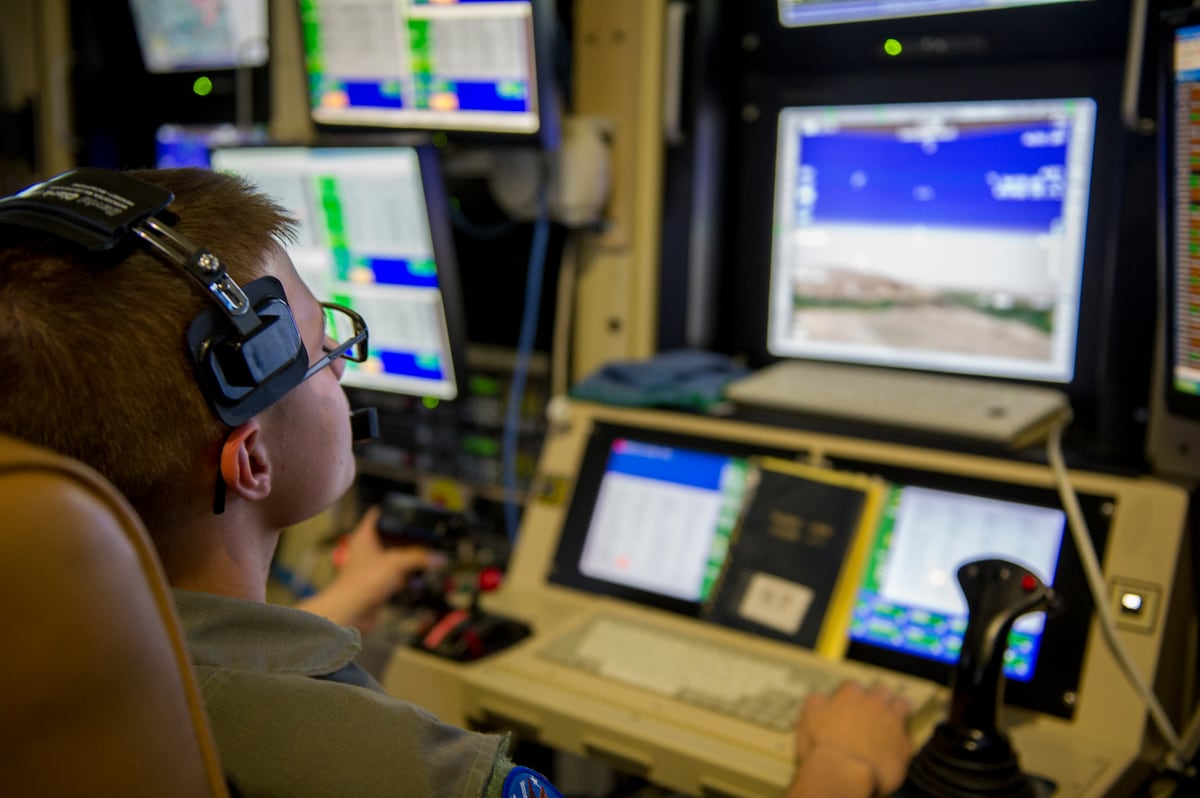
Tucked inside the more than 3,000 pages of the recently passed defense budget for Fiscal Year 2026 is a mandate that the secretary of defense carry out a study focused on the mental health impacts of piloting unmanned aircraft systems in combat.
The rise of military drone pilots as a profession has brought with it a fair share of jeers and suspicion. In 2013, when the Pentagon rolled out a “Distinguished Warfare Medal” to honor drone operators, troops dubbed it the “Nintendo Medal.”
It was canceled soon after and replaced with an “R” device — for “remote warfare” — in 2016. But research shows that the impacts of combat trauma on drone operators are real, and could be even more profound than those on pilots of manned aircraft.
A 2023 literature review published in the Journal of Mental Health & Clinical Psychology found that crews of remotely piloted aircraft “exhibit greater psychiatric symptoms, in general, as compared to crews that work with crewed military aircraft.”
Seth Norrholm, an associate professor of Psychiatry at Wayne State University in Michigan and the lead author on the study, told Military Times that, perhaps counterintuitively, remote warfare requires a level of intimacy with a prospective strike target that conventional air warfare may not.
“A lot of these pilots and crews are tracking targets for a period of weeks, months and sometimes years. They get to know the daily lives of the people that they’re tracking,” Norrholm said. “They may be playing soccer, football, you know, outside, eating meals together. So, you really see this person’s life. And you get to know this person from afar, and then potentially you’re given the order to take them out, you know, the next day. So there’s unique intimacy that can develop between the targets and the RPA crews, because they really have gotten to know this person at a really personal level, even though they’ve never met.“
Then there’s the potentially jarring juxtaposition of conducting strikes with lethal effects from a U.S.-based operations center and being able to re-enter the comforts of everyday American life following a work shift.
Norrholm noted that the services have made changes to create clearer lines between combat operations and home life, to prevent what has been called “psychological whiplash.”
“The long-term effects of these types of ‘whiplash’ are still being investigated and not yet well understood,” the paper notes.
According to the language in the recently enacted National Defense Authorization Act for Fiscal 2026, the Pentagon study must include an “assessment of the prevalence of post-traumatic stress disorder, depression, anxiety, burnout, moral injury and other mental health conditions” among not only the pilots who fly combat drones but also those who analyze combat imagery or conduct targeting assessments.
These rates will be compared against those of aircrew who engage in conventional combat flight operations and troops deployed in non-combat flying roles.
It also must evaluate unique operational stressors for RPA pilots, including “shift work and sleep disruption; remote witnessing of lethal operations; emotional disengagement and isolation; and exposure to civilian casualties or traumatic visual content.”
Included in the study will also be an assessment of available mental health support services and an evaluation if those services are “adequate, accessible, and appropriately tailored” for RPA pilots, along with recommendations for improving screenings, treatment and prevention.
The report will be due to the House and Senate Armed Services Committees no later than this December.
It’s not the first time Congress is expressing concern over the wellbeing of military drone pilots. In 2023, lawmakers called on the Air Force to work with U.S. Special Operations Command to adopt a program that would support RPA pilots’ holistic wellbeing.
As far back as 2014, an Air Force study of 1,000 drone pilots documented the prevalence of post-traumatic stress disorder in the community.
For Norrholm, the new study mandate is significant because the data it produces will drive resource allocation and development of policy.
“The military tends to work slowly in terms of affecting change,” he said. “But if there’s data out there that suggests that you can improve operator readiness by taking some of these steps, you know, they’re receptive to it.”
While the rise of increasingly capable autonomous platforms is once again recasting the role of human operators in combat, Norrholm said the presence of a human in the loop means the question of psychological impacts and how to treat them will remain relevant.
“It’s not going to be a reliance on technology alone. It’s not going to be an AI-driven decision to carry out these missions, or at least it shouldn’t be,” he said.
“Anytime there’s a human element, there’s always the possibility for psychological consequences, which affects operational readiness and national security,” he added. “So, as long as humans are engaged in warfare, whether it’s conventional or remote warfare, there’s always the potential for psychological consequences. … That needs to be addressed, and will continue to need to be addressed.”