


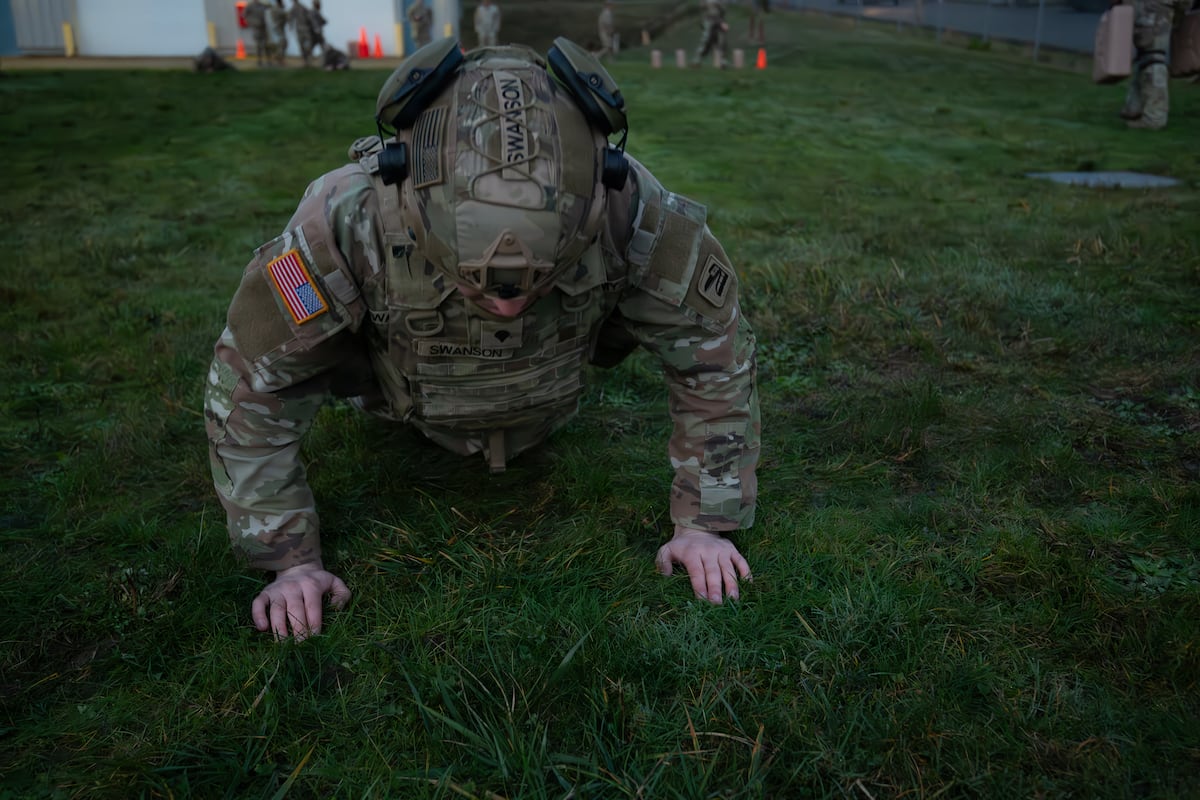
The Washington National Guard is shaving four months off its Officer Candidate School timeline while keeping training standards and hour requirements unchanged, according to an Army press release.
The change shortens the program’s Phase II portion from 12 months to eight by extending monthly drill weekends from two days to three, a shift the Guard says that will keep the total training hours identical while accelerating the path to commissioning.
Lt. Col. Nicholas Zaharavech, who oversees the program, said the change was driven by broader National Guard training requirements and is similar to changes already adopted in other states.
“The compressed cycle drops down into eight drill weekends, so we shaved four months off the traditional program from 12 to eight,” he said.
Zaharavech said the shorter timeline could also make the program more appealing to experienced noncommissioned officers who may have avoided making the hump because of the traditional course length.
Capt. Eric Dunkley, the OCS company commander, said the cadre will monitor how the new schedule affects officer candidate development.
“We will get a good feel for it this year,” he said in the release, adding that leaders will now need to flex different skills to manage standards with the new timeline.
Under the new schedule, the course’s Phase III will now take place in March and April, meaning the final field training will be in colder, wetter weather. Cadre are planning for an increase in cold weather injuries. Dunkley said the conditions will add stress but better reflect the realities soldiers in operational units face.
“Also, there is something to be said for embracing the suck. It’s learning that resiliency by facing adversity,” Dunkley said.
Despite the condensed calendar, candidates will still need to meet the same academic, physical and leadership requirements. According to the release, students must continue to pass written exams about military history, complete standard ruck marches, meet running baselines and participate in multi-day field training exercises. Each candidate also undergoes repeated leadership assessments.
Zaharavech said recent classes have seen high attrition rates, with only five officer candidates graduating the most recent cycle.
First Lt. Josh Peters, who commissioned in 2022, said the longer program length contributed to people dropping out of his class. “We started with 23 candidates and graduated five,” he said, adding, “I think the shorter timeline would have helped keep more people in.”
Eve Sampson is a reporter and former Army officer. She has covered conflict across the world, writing for The New York Times, The Washington Post and The Associated Press.