


Lt. Kermit Tyler’s eyes lit up at what he saw on his screen: a large blip 132 miles north of the Hawaiian island of Oahu.
It was just after 7:02 a.m., and the skeleton crew working the night shift at the Aircraft Information Center at Fort Shafter also were mystified by the reading that had caught Tyler’s eye.
Could their radar equipment be malfunctioning? Just how many planes were incoming?
And most importantly — were they American?
It was Dec. 7, 1941, and the world would soon be shocked by the deadly events that followed, drawing the U.S. into World War II.
Meanwhile, as those American crews watched their radar, a small, 40-ton submarine known only by its assigned battle number, HA-19, was cutting through the waves nearby, wrote Bill Newcott for the National Geographic.
Even before the first Japanese bomb fell on Pearl Harbor, the HA-19 and four other Type A Kō-hyōteki-class midget submarines were meant to deal the first blow to the “sleeping giant” in the harbor.
Most didn’t get that far, however.
“Because the small subs had to surface frequently for fresh air, four of them were sighted by patrolling ships and destroyed with depth charges,” wrote Newcott.
It was here — just outside the harbor’s edge — that the first spirited American defense of Pearl occurred — not from fierce, modern destroyers, but from the USS Ward, a Wickes-class destroyer from a seemingly bygone era — the ship first touched water in 1918.
Tragically, however, an incident report by Ward’s crew wasn’t heeded. If it had, the U.S. would not have been caught so off guard by the attack on Pearl Harbor.
“I was not at all certain that this was a real attack,” Admiral Husband E. Kimmel, commander in chief of the U.S. Pacific Fleet, later said of Ward’s report.
According to the Naval History and Heritage command, at least one of the midget subs was able to enter the harbor before being sunk there by USS Monaghan.
The HA-19, on the other hand, never even got close.
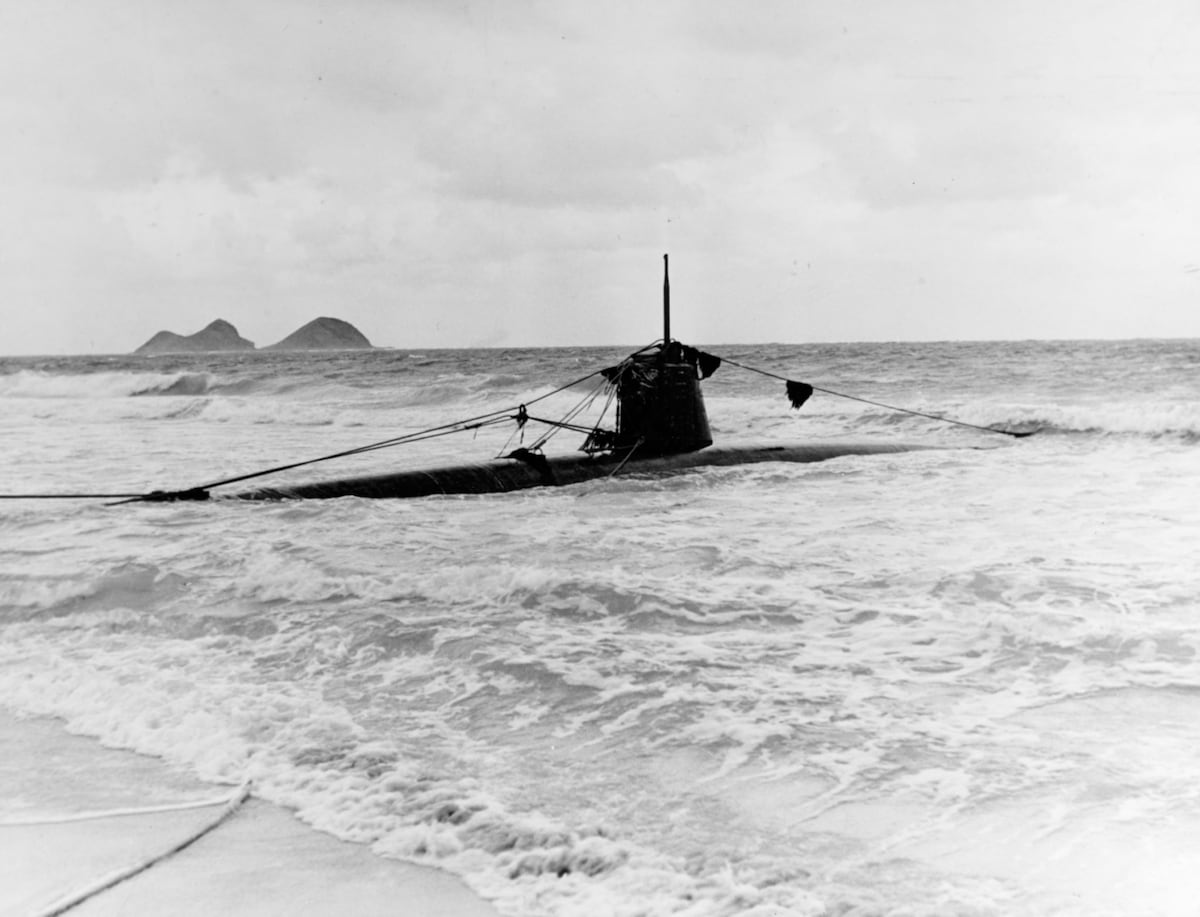
Ensign Kazuo Sakamaki and Chief Warrant Officer Kiyoshi Inagaki, the two-man crew inside HA-19, had difficulties from the outset. Their gyrocompass didn’t work, and they spent the early hours of Dec. 7 bumping along the rocks and coral reef outside Pearl Harbor.
In fact, when the Japanese bombardment began, HA-19 could be found there — stuck.
According to The National World War II Museum, it was there that the USS Helm spotted the foundering vessel and opened fire.
“The shells fell close enough to knock Sakamaki unconscious as Inagaki dived the submarine away from trouble. After pulling themselves together, the pair made more attempts at entering the harbor, battering the bow of the submarine to the point the torpedoes would no longer fire. Seawater entered through the crushed nose of HA-19 and slowly began to surround the batteries, which were now emanating toxic fumes,” the museum wrote.
With no chance of survival inside the doomed vessel, the two men decided to abandon ship and prepared to engage in hand-to-hand combat to the death once on shore.
But before they could, the fumes overwhelmed the pair, knocking them unconscious. They awoke that evening, having missed the attack on Pearl Harbor.
Only Sakami made it to shore alive. Inagaki drowned after he attempted to set off an explosive charge to destroy the midget sub.
Crawling ashore, Sakamaki soon faced down the tips of American rifles. He begged to be killed, but the GIs refused to acquiesce.
Thus, Sakamaki garnered the dubious distinction of becoming the first Japanese POW of World War II.
Since that day of infamy, four of the five Japanese midget submarines have been found, with the HA-19 currently on display in Fredericksburg, Texas in the National Museum of the Pacific War.
Some historians contend, controversially, that one of the midget submarines managed to fire its torpedoes at the USS Oklahoma or the USS West Virginia and may still be lurking below the depths of the harbor.
Even so, “You have 300 aircraft in the sky and five midget subs,” Robert Citino, senior historian at The National WWII Museum, told History.com. “Even if each one had a direct hit, there was so much more ordnance flying through the air than gliding under the seas. In the shadow of that, the submarines become a footnote.”
Claire Barrett is the Strategic Operations Editor for Sightline Media and a World War II researcher with an unparalleled affinity for Sir Winston Churchill and Michigan football.